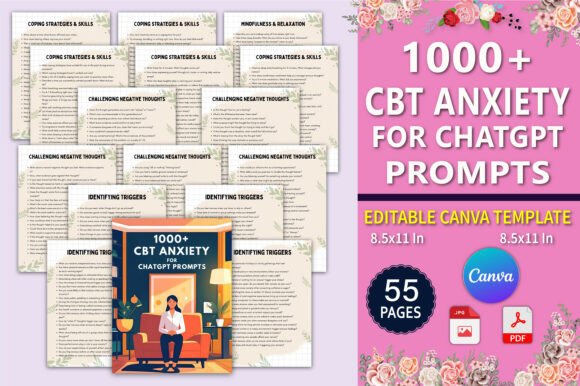
🌿 1000 CBT Anxiety Prompts Planner
What if your journal didn’t just hold thoughts—but helped reshape them? The 🌿 1000 CBT Anxiety Prompts Planner is a thoughtfully structured, clinically grounded resource built on Cognitive Behavioral Therapy principles. It’s not a quick fix or a passive PDF—it’s an active toolkit: 1000 targeted prompts organized across ten functional domains, from trigger awareness to social anxiety support. Each prompt invites reflection, not judgment; action, not overwhelm.
Why This Matters—Differently—for Different People
For a freelance graphic designer juggling deadlines and self-doubt, anxiety shows up as procrastination before client revisions—or physical tension while reviewing feedback. For a high school teacher managing classroom stress and after-hours grading, it surfaces as irritability or mental exhaustion by 4 p.m. A small business owner might feel it as decision paralysis before launching a new service. Though the emotion feels similar, its context, cost, and consequences vary widely. That’s why a one-size-fits-all worksheet rarely sticks—and why the 🌿 1000 CBT Anxiety Prompts Planner prioritizes flexibility over rigidity.
Beginners: Clarity Without Complexity
If you’ve never tried CBT—or even heard the term—you don’t need background reading to begin. The planner scaffolds learning gently: early prompts ask simple questions like *“What was happening right before I felt my heart race?”* or *“What’s one neutral fact I can name about this situation?”* These build foundational awareness without demanding clinical knowledge. There’s no pressure to “get it right.” Just show up, write honestly, and notice what shifts—even slightly—over time.
Experienced Practitioners & Therapists
Clinicians and coaches often seek supplemental tools that align with evidence-based practice—not gimmicks. This planner avoids oversimplification: its thought-reframing section uses classic CBT structures (e.g., identifying cognitive distortions like catastrophizing or mind-reading), while its exposure tracking supports graded behavioral activation. Many therapists use select pages as handouts or integrate prompts into session prep—especially when clients benefit from consistent between-session practice.
Creators & Educators
Writers, bloggers, and educators regularly translate complex ideas into accessible formats. The editable Canva link isn’t just for personal use—it’s a design-ready foundation. One curriculum developer adapted 30 mindfulness prompts into printable classroom cards for middle-school SEL lessons. A wellness blogger layered her own voice over selected coping-skills templates to create a free downloadable mini-guide for her email list. The 55 Canva templates offer visual variety without requiring design skills—ideal when authenticity matters more than polish.
Professionals & Entrepreneurs
Time is nonrenewable. That’s why professionals value the planner’s intentional structure: daily check-ins take under three minutes; problem-solving prompts follow a clear 4-step flow (*Define → Explore options → Choose → Reflect*); confidence-building exercises fit neatly into morning routines. One marketing manager used the “social anxiety support” section to rehearse difficult conversations—like asking for budget approval—before meetings. She reported feeling less reactive and more prepared, not because she eliminated nerves, but because she’d already practiced naming and redirecting them.
Hobbyists & Lifelong Learners
This planner meets people where they are—not where they “should” be. A retired nurse used the self-reflection journaling prompts to process grief and identity shifts after leaving full-time work. A hobbyist photographer printed specific mindfulness pages to carry in her camera bag, using grounding prompts before shooting in unfamiliar locations. Its usefulness isn’t tied to diagnosis or severity. It’s for anyone who wants to understand their inner landscape with more kindness and precision.
What Makes It Work—Beyond the Number “1000”
The volume matters less than the curation. Each prompt serves a purpose:
- Trigger Awareness helps spot patterns—like noticing how low blood sugar + back-to-back Zoom calls reliably spikes anxiety, making meal timing a tangible self-care lever.
- Thought Reframing doesn’t insist you “think positive.” Instead, it asks: *“What’s another way someone who cares about me might interpret this?”*—inviting perspective, not pressure.
- Exposure Progress Tracking supports gradual growth. One user started by writing the name of a feared task (e.g., “calling customer service”)—then moved to drafting the script, then making the call. Small steps, visible progress.
- Daily Check-ins aren’t about perfection. They’re data points. Over weeks, users often spot surprising links—like higher calm on days with morning movement, regardless of workload.
Fitting It Into Real Life
You don’t need to use all 1000 prompts. You might start with just the “Mindfulness Relaxation” section for two weeks—using one breathing or sensory grounding prompt each morning. Or focus solely on “Coping Skills” during a high-stress project phase. The PDF files print cleanly at 8.5×11”, and the Canva link lets you customize fonts, colors, or add your logo—useful whether you’re sharing resources with students or building a branded client toolkit.
It’s also designed for longevity. Unlike apps that sunset or require subscriptions, this is yours—download it once, print it, annotate it, revisit it years later. No login. No algorithm deciding what you “need” next. Just quiet, consistent support.
Does It Fit Your Goals?
Ask yourself:
- Do you want to understand your anxiety—not just suppress it?
- Do you prefer writing by hand or typing into a flexible digital file?
- Are you looking for structure that adapts to changing needs—not a rigid program?
- Do you value clinical grounding without clinical jargon?
- Is long-term usability (not just novelty) important to you?
If yes, the 🌿 1000 CBT Anxiety Prompts Planner offers more than prompts. It offers permission—to pause, question gently, experiment, and grow at your own pace. Not toward some ideal state of calm, but toward deeper self-trust, one thoughtful sentence at a time.