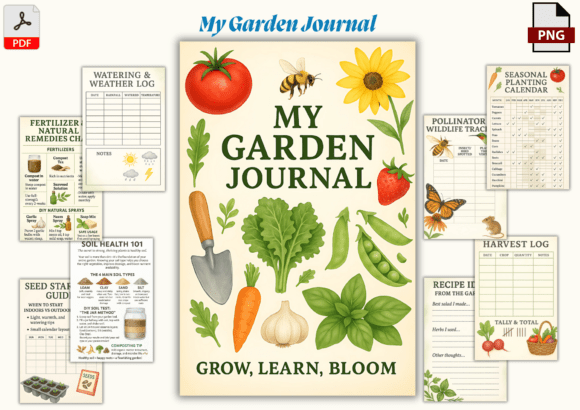
My Garden Journal Fun Educational
My Garden Journal Fun Educational is an 18-page, 6x9 inch printed journal designed to support gardeners in observing, recording, and learning from their growing practices. It is not a digital app or a blank notebook—it’s a guided logbook with watercolor illustrations and purpose-built sections that blend horticultural basics with reflective tracking. Each page serves a functional role: from soil testing prompts to seasonal planting reminders, pest logs to pollinator observations.
Who Might Find This Journal Useful?
Gardeners who value structure without rigidity may find My Garden Journal Fun Educational helpful—especially those new to gardening or returning after a break. It suits home gardeners managing small plots, balcony containers, or community allotments. Because it includes foundational concepts like soil type identification and companion planting logic, it supports learning while doing—not through abstract theory, but through applied reflection.
It also appeals to educators, parents, or youth program leaders using gardening as a hands-on science tool. The sketching spaces, growth stage diagrams, and “Garden Wins Lessons” section encourage observation skills and critical thinking—making it more than a record-keeping tool.
Key Benefits: Practicality Meets Learning
The journal’s strength lies in its intentional scaffolding. For example:
- Soil Health 101 introduces the four primary soil types (sand, silt, clay, loam) and walks users through a simple, at-home texture test—no lab required.
- The Companion Planting Chart avoids oversimplification; it notes common pairings while acknowledging context—e.g., “Basil may deter tomato hornworms, but effectiveness varies by region and pest pressure.”
- The Garden Tracker provides consistent fields for planting date, germination window, and first harvest—enabling pattern recognition across seasons without demanding daily entries.
- The Pest Problem Log guides users to document symptoms, timing, and interventions—not just outcomes—supporting more informed future decisions.
- Seasonal Planting Calendar offers month-by-month suggestions aligned with typical temperate-zone growing windows, with space to annotate local frost dates or microclimate adjustments.
Unlike generic notebooks, this journal reduces cognitive load: users aren’t deciding what to track—they’re guided toward data points that actually inform better choices over time.
Tradeoffs and Realistic Expectations
Because it’s a fixed-format printed journal, My Garden Journal Fun Educational doesn’t scale with large-scale operations. Commercial growers or those managing dozens of crop varieties may quickly outgrow its 18 pages. Similarly, gardeners who prefer digital tools—like apps with weather integration, photo logging, or automated reminders—won’t find those features here.
The journal assumes basic literacy in English and comfort with handwritten notes. It does not include translations, Braille, or audio support. While the watercolor illustrations add visual clarity, they don’t replace detailed botanical diagrams or scientific references—so it’s best paired with extension resources or field guides for deeper study.
Also, because it’s a single-use physical product, users should consider whether they’ll fill it within one growing season—or if they’d benefit more from a reusable or multi-year format. Some gardeners report reusing similar journals annually; others prefer starting fresh each year to compare notes side-by-side.
When This Journal Is a Strong Fit
My Garden Journal Fun Educational works well for gardeners who:
- Want to build consistent observational habits without feeling overwhelmed by data entry.
- Are curious about soil health, plant interactions, or ecological relationships—but don’t yet know where to begin gathering meaningful information.
- Value reflection as part of learning—e.g., reviewing “Garden Wins Lessons” helps identify which interventions succeeded (or failed) and why.
- Prefer tactile, screen-free engagement—especially when teaching children or working outdoors where devices are impractical.
- Need lightweight, portable documentation—for example, jotting notes during a morning walk through the garden or while waiting for seedlings to emerge.
Its compact size and focused scope make it especially suitable for first-time vegetable growers, school garden programs, or therapeutic horticulture settings where process matters more than output volume.
When Alternatives May Be Worth Considering
If your goals involve long-term trend analysis—say, comparing soil moisture patterns over three years or mapping pest outbreaks across multiple zones—a spreadsheet or dedicated garden app (like GrowIt! or Garden Planner) may offer more flexibility and searchability.
For gardeners managing complex rotations, irrigation systems, or certified organic compliance, more specialized tools—such as farm management software or university extension checklists—provide regulatory alignment and scalability that My Garden Journal Fun Educational does not aim to replicate.
Those seeking deep botanical detail—like cultivar-specific disease resistance or precise nutrient uptake curves—will still need supplemental references. This journal introduces concepts; it doesn’t serve as an exhaustive encyclopedia.
Making a Practical Decision
Ask yourself two questions before choosing My Garden Journal Fun Educational:
- What do I most want to learn or improve this season? If your goal is understanding why certain plants thrive while others struggle—and you’re willing to spend 5–10 minutes weekly recording observations—this journal aligns well. If you mainly need quick reminders or task lists, simpler tools may suffice.
- How do I currently capture garden information—and what gaps exist? If you already use apps but forget to log pests or skip soil checks, adding a low-friction physical journal can fill those gaps. If you rarely record anything at all, this journal lowers the barrier to starting—without requiring setup or tech literacy.
It’s also worth considering how you’ll use insights afterward. The journal encourages reflection, but turning notes into action depends on follow-through: reviewing past entries before planning next season, cross-referencing pest logs with regional extension advisories, or sharing sketches with local gardening groups for feedback.
In summary, My Garden Journal Fun Educational is a thoughtfully structured entry point—not a comprehensive solution. Its value emerges most clearly when used intentionally, alongside curiosity and consistency. For gardeners ready to grow smarter—not just harder—it offers a grounded, accessible way to deepen practice, one season at a time.