2025–2026 Invoice Self-Employed Book
For freelancers, consultants, and small business owners managing income and expenses across multiple clients, consistent, professional invoicing isn’t just administrative—it’s foundational. The 2025–2026 Invoice Self-Employed Book is a printable, Canva-compatible interior template designed specifically for Kindle Direct Publishing (KDP), offering a structured yet flexible way to record, track, and reference billing activity over two full fiscal years. Unlike generic blank notebooks or digital-only tools, this resource bridges analog workflow preferences with modern publishing standards—making it relevant for creators who value physical documentation but also need KDP-ready files.
What It Is—and What It’s Built For
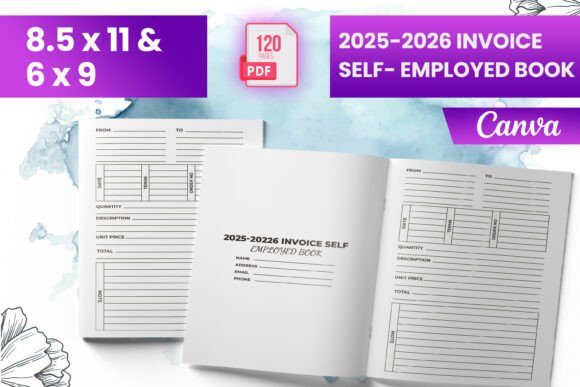
The 2025–2026 Invoice Self-Employed Book is a 120-page interior file intended for self-publishing as a physical planner or ledger on Amazon KDP. It includes pre-formatted invoice log pages, date-stamped sections spanning January 2025 through December 2026, and supporting elements like an introduction page and summary prompts. Its design assumes users will print and bind the PDF—or upload it directly to KDP for print-on-demand distribution. Importantly, it’s not software or a SaaS tool; it’s a static, ready-to-use layout optimized for clarity, consistency, and compliance with KDP’s technical requirements.
Key Technical and Design Features
This version stands out for its attention to production details—especially for those unfamiliar with KDP’s formatting constraints. All files include bleed (typically 0.125 inches), ensuring no critical content gets trimmed during printing. The interior is provided in multiple standard trim sizes: 6″ × 9″, 8.5″ × 11″, and A4 (used internationally). Each size is delivered as a separate, tested PDF—no resizing or reformatting needed. In addition to the primary PDFs, PNG and JPG versions are included, which may be useful for preview thumbnails, marketing visuals, or editing in external tools like Canva before final export.
The 120-page count balances utility with practicality: enough space to log dozens of invoices per month without feeling sparse or overwhelming. Pages follow a logical sequence—starting with an introductory spread explaining usage, followed by monthly breakdowns, and ending with summary tables for quarterly and annual totals. There’s no decorative clutter; fonts are legible at print size, spacing supports handwriting, and margins respect bleed zones. That level of intentionality matters when your goal is usability—not aesthetics alone.
How It Performs in Real-World Use
In practice, the 2025–2026 Invoice Self-Employed Book works best for individuals who prefer tactile tracking alongside digital bookkeeping. A freelance graphic designer, for example, might use it to jot down client names, invoice numbers, due dates, and payment statuses while waiting for bank transfers to clear—then later reconcile those entries with QuickBooks or Wave. Similarly, educators offering private tutoring or workshop facilitators billing schools or nonprofits often find value in having a dated, physical record that complements email trails and contracts.
Because the interior is bleed-ready and KDP-tested, users report fewer upload rejections or print misalignment issues compared to DIY templates. One user noted that after uploading the 6″ × 9″ PDF directly to KDP, their proof arrived with clean edges and properly aligned headers—no manual bleed adjustment required. That reliability reduces iteration time, especially for first-time KDP publishers unfamiliar with crop marks or CMYK conversion nuances.
Who Benefits Most—and When
The 2025–2026 Invoice Self-Employed Book serves three main groups particularly well:
- Freelancers and solopreneurs who invoice irregularly or across multiple industries—its dual-year span accommodates shifting project timelines without needing to switch notebooks mid-cycle.
- KDP publishers building niche productivity toolkits—for example, bundling this interior with a branded cover and selling it as part of a “Self-Employed Essentials” series. The inclusion of PNG/JPG assets supports custom cover design workflows.
- Educators and trainers teaching financial literacy or small business fundamentals—where a printed, dated logbook offers students a low-tech, accessible model for understanding cash flow timing and tax preparation basics.
It’s less suited for teams requiring real-time collaboration, automated calculations, or integration with accounting APIs. If your workflow depends on recurring invoice generation, tax-code auto-filling, or multi-currency support, dedicated software remains more appropriate. But if you’re looking for a dependable, offline-first companion to verify what’s been sent, received, and followed up on—this delivers without overcomplication.
Flexibility Without Compromise
One strength of the 2025–2026 Invoice Self-Employed Book lies in how easily it adapts to different working styles. Because the source files are editable in Canva (via imported PDF layers or PNG overlays), users can personalize headers, add logos, adjust color schemes, or insert custom fields—say, “Platform Used” for digital creators or “Contract Reference #” for consulting engagements—before finalizing the KDP upload. That modularity means it doesn’t lock you into one structure. You retain control over branding and functional emphasis while benefiting from professionally vetted layout logic.
Still, there are limits to consider. The interior uses fixed page counts and static date ranges—so if you start using it in March 2025, the early months remain blank. There’s no built-in indexing or tabbed dividers, which some users might expect for quick navigation. And while the font is readable, it’s not optimized for extremely fine handwriting—those with tight script may want to test print a sample page before committing to bulk production.
Long-Term Value and Practical Fit
From a longevity standpoint, the 2025–2026 Invoice Self-Employed Book holds up because its utility isn’t tied to platform updates or subscription renewals. Once downloaded, the files remain usable indefinitely—no login, no expiration, no cloud dependency. That stability appeals to professionals prioritizing data sovereignty and minimal digital overhead. It also aligns well with hybrid workflows: scan completed pages into Evernote or Notion for searchability, while keeping originals bound and archived.
If you're evaluating whether this fits your current needs, ask yourself two things: Do you regularly issue invoices outside of automated systems? And do you benefit from having a chronological, tangible record that aligns with calendar-year tax cycles? If both answers are yes, then the structure, production readiness, and thoughtful sizing of the 2025–2026 Invoice Self-Employed Book make it a pragmatic choice—not just another template, but a purpose-built tool calibrated for real-world financial documentation.