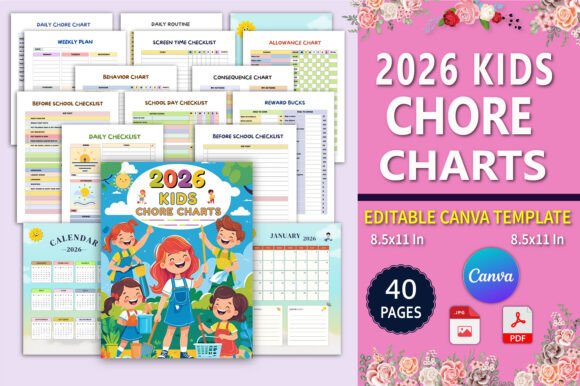
2026 Kids Chore Chart Planner
Managing daily responsibilities with children often feels less like routine-building and more like constant negotiation—especially when expectations shift, motivation dips, or screen time quietly overtakes structure. The 2026 Kids Chore Chart Planner addresses this not by adding complexity, but by offering a cohesive, visually grounded system that aligns with how kids learn, respond, and grow. It’s designed for families who want consistency without rigidity, accountability without pressure, and progress that’s visible—not just assumed.
A Year-Long Framework That Grows With Your Child
The 12-month 2026 calendar isn’t just decorative—it’s functional scaffolding. Unlike single-month printables that get lost or abandoned by February, this planner supports long-term habit formation by letting kids see how small, repeated actions accumulate across seasons. A 7-year-old tracking “make bed” every morning in January builds different neural pathways than the same child doing it sporadically in March. The calendar reinforces continuity, helping parents notice patterns: Is resistance higher on school mornings? Does participation improve when chores are paired with a shared ritual, like breakfast together? That visibility supports responsive parenting—not just task management.
Chores That Fit Real Life—Not Just Checklists
Daily and weekly chore charts separate tasks into logical time blocks: morning (e.g., pack lunch, feed pet), afternoon (e.g., clear table, water plants), and evening (e.g., tidy toys, choose tomorrow’s clothes). This mirrors natural energy rhythms and avoids overwhelming kids with one dense list. For neurodivergent children or those with executive function challenges, the temporal framing—“what happens *after* school” versus “what happens *before* bedtime”—reduces ambiguity and decision fatigue. Parents report fewer power struggles when expectations are tied to existing anchors (e.g., “After homework, you earn 2 reward bucks for folding laundry”) rather than abstract deadlines.
Reward Bucks: Teaching Value, Not Just Compliance
The Buck Tracker moves beyond stickers or vague praise. Each completed chore earns a specific number of “bucks,” which kids can save, spend, or budget across categories (e.g., $5 for extra screen time, $10 for a library trip, $20 toward a small toy). This introduces foundational financial literacy—delayed gratification, trade-offs, goal-setting—all within a low-stakes context. One educator used it with her third-grade class during a unit on economics; students tracked their “chore income” alongside classroom jobs, then compared spending choices in small groups. The system works because it’s concrete, scalable, and tied to real-world cause-and-effect.
Behavior Charts That Reinforce, Not Punish
Instead of focusing solely on what not to do, the behavior consequence charts emphasize observable, positive alternatives. Rather than “no yelling,” it might prompt “use calm voice + take three breaths.” The layout pairs each behavior with a visual cue (a sun icon for “sunshine attitude,” a lightbulb for “problem-solving moment”), making abstract social-emotional goals tangible. For kids who struggle with self-regulation, seeing progress in a chart—“I used my calm voice 4 days this week”—builds agency faster than verbal reminders alone.
School & Screen Time: Two High-Friction Areas, Solved Differently
The School Checklist splits preparation into before-school (e.g., “check backpack for signed papers,” “pack water bottle”) and after-school (e.g., “hang coat,” “log homework in planner”). This reduces morning chaos and after-school meltdowns by externalizing memory load—critical for kids still developing working memory. Similarly, the Screen Time Checklist doesn’t ban devices but structures usage: “Earn 15 minutes of tablet time by completing 3 morning tasks.” It turns negotiation into collaboration, and limits into earned privileges.
Routine Schedules That Respect Developmental Needs
The hourly Daily Routine Schedule isn’t prescriptive down to the minute—it’s flexible enough for homeschoolers, early-risers, or families with after-school activities. A parent of twins adjusted the template to show parallel columns: “Liam’s 4–5 p.m. = soccer practice” next to “Maya’s 4–5 p.m. = art journaling.” That small customization reduced sibling comparisons and made transitions smoother. The planner’s design encourages these kinds of adaptations—its editable Canva link lets users adjust colors, fonts, icons, or even add bilingual labels without design skills.
Habit Tracking Beyond Chores
The Habit Tracker expands focus from “chores I must do” to “skills I’m growing”: reading 10 minutes nightly, practicing gratitude, or trying one new food per week. Tracking these alongside chores normalizes growth as multidimensional—not just about responsibility, but curiosity, resilience, and self-awareness. One therapist recommended it to clients’ families to support anxiety reduction: noticing “I did my breathing exercise 5/7 days” created measurable evidence of coping skill development.
Communication Built Into the System
The Notes & Reminders sections aren’t afterthoughts—they’re intentional bridges. A child might draw a smiley face next to “helped Dad fix the bike” and write “felt proud.” A parent might note, “Offered choice: vacuum living room *or* wipe baseboards.” These exchanges build mutual understanding and reduce assumptions. In blended families or households with multiple caregivers, the shared space ensures consistency without requiring constant text updates.
Who Benefits Most—and When to Consider Alternatives
This planner shines for families with children aged 4–12 who respond well to visual systems and benefit from structure—but it’s not one-size-fits-all. Children who thrive on spontaneity or resist external tracking may need lighter-touch tools first (e.g., verbal routines, photo-based checklists). Families managing complex schedules—multiple schools, therapies, or travel—may prefer digital tools with calendar sync. Still, the printable PDFs and Canva templates offer flexibility: print only the pages you use, laminate high-frequency charts, or convert sections into classroom posters.
Practical Integration, Not Perfect Execution
No planner fixes inconsistency—but the 2026 Kids Chore Chart Planner reduces friction so consistency becomes easier to sustain. You don’t need to launch every feature on January 1st. Start with the Daily Chore Chart and Reward Bucks. Add the School Checklist once routines settle. Introduce the Habit Tracker mid-semester. Its value lies in modularity, clarity, and alignment with developmental science—not perfection. When a child points to their chart and says, “I did all my jobs today,” that’s not just compliance. It’s the quiet beginning of self-trust.