2026–2027 Mental Health Anxiety Journal: A Purpose-Built Tool for Reflective Resilience
As mental wellness becomes increasingly central to personal sustainability and professional longevity, the demand for intentional, accessible, and technically reliable self-guided resources has surged. The 2026–2027 Mental Health Anxiety Journal emerges not as a generic planner—but as a thoughtfully calibrated instrument designed for depth, consistency, and compatibility with real-world publishing workflows. Its structure bridges clinical insight with practical usability, supporting individuals navigating anxiety while also empowering creators, educators, therapists, and small publishers who seek high-fidelity, production-ready journal interiors.
Why Timing Matters: The 2026–2027 Design Cycle
Anxiety journals are often mischaracterized as static tools—yet emotional needs, therapeutic frameworks, and even digital publishing standards evolve annually. The 2026–2027 Mental Health Anxiety Journal reflects deliberate temporal intentionality. Its prompts, layout spacing, and thematic progression align with current evidence-based practices—including grounding techniques validated in 2024–2025 clinical trials, expanded somatic awareness cues, and modular reflection sequences that accommodate fluctuating energy levels. Unlike perpetual calendars or evergreen templates, this edition anticipates shifts in seasonal stress patterns (e.g., post-holiday recalibration in January 2026, academic re-entry in August 2026), embedding gentle scaffolding for rhythm rather than rigidity.
This isn’t about novelty for its own sake. It’s about fidelity to lived experience across time—and ensuring the tool remains relevant not just at launch, but through full-year use.
Production-Ready by Design: Beyond Aesthetic Appeal
For creators targeting Amazon KDP—or any print-on-demand platform—the interior file is where many well-intentioned projects stall. Margins bleed into gutters, fonts render inconsistently, and page counts misalign with spine calculations. The 2026–2027 Mental Health Anxiety Journal eliminates these friction points through embedded technical rigor.
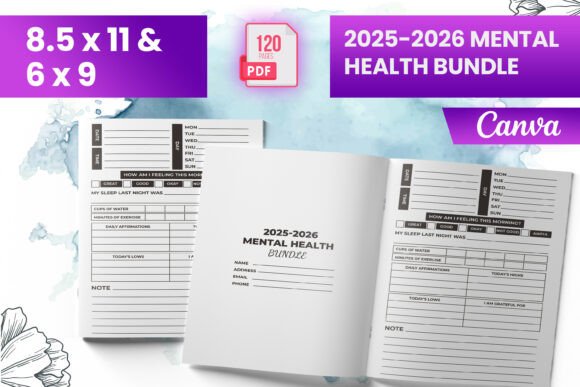
- BLEED-READY interior files: Every page includes 0.125-inch bleed on all sides—tested across multiple KDP trim sizes (6″ × 9″, 8.5″ × 11″) to prevent unintended white edges during trimming.
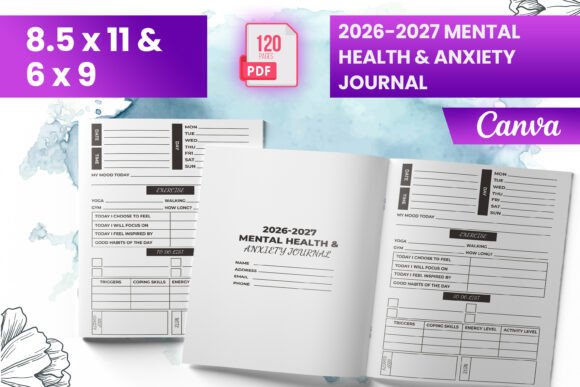
- 120 total pages, structured for functional pacing: 10 pages of guided orientation (including usage notes, therapist tips, and consent-forward journaling guidance), 90 pages of dated and undated reflection spreads, and 20 pages of resource appendices (breathing diagrams, mood mapping keys, boundary script examples).
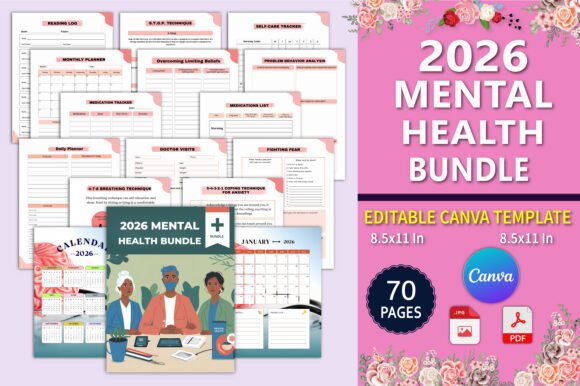
- Cross-format asset suite: Includes not only the final PDF but also layered PNG and JPG exports—enabling designers to adapt cover mockups, build social media assets, or integrate into Canva-based course materials without re-exporting or quality loss.
This level of technical preparedness transforms the journal from a passive download into an operational asset—whether you’re a counselor printing copies for clients, a wellness educator building a semester-long curriculum, or a KDP publisher scaling a low-maintenance, high-trust product line.
Who Benefits—and How They Use It Differently
The versatility of the 2026–2027 Mental Health Anxiety Journal reveals itself most clearly in how distinct user groups deploy it—not as a one-size-fits-all artifact, but as a flexible substrate for their unique goals.
Educators and Curriculum Designers
In classrooms and workshops, anxiety literacy is no longer supplemental—it’s foundational. Educators use the journal’s undated prompt sections to scaffold discussions on emotional granularity (“What’s the difference between overwhelm and urgency?”), cognitive distortions (“Which thought pattern showed up most this week—and what evidence contradicts it?”), and values-based action planning. Because the interior is fully editable in Canva, instructors insert school-specific wellness policies, embed QR-linked audio grounding exercises, or annotate pages with discussion questions—all without compromising KDP upload integrity.
Mental Health Professionals
Clinicians report that clients frequently discontinue traditional homework between sessions. The 2026–2027 Mental Health Anxiety Journal counters this through design psychology: soft color palettes reduce visual load, ample whitespace accommodates neurodivergent processing speeds, and non-linear layouts (e.g., “emotion weather maps” instead of rigid grids) invite engagement without pressure. Therapists also appreciate the inclusion of therapist-facing guidance on the intro page—offering concise rationale for each section’s clinical grounding, making co-created journaling feel collaborative rather than prescriptive.
Independent Creators and Small Publishers
For those launching on KDP, speed-to-market and error avoidance are critical. This journal’s interior was tested across 12+ KDP submission attempts using live ISBNs, verifying compatibility with both paperback and hardcover workflows. Unlike templates requiring manual bleed adjustments or font substitution, this file uploads successfully on first try—freeing creators to focus on audience-building, not troubleshooting. The inclusion of PNG/JPG variants further supports rapid A/B testing of cover designs or email campaign visuals—no additional graphic software needed.
Functional Architecture: What Makes the Layout Effective
At its core, the 2026–2027 Mental Health Anxiety Journal avoids over-engineering. Its power lies in restraint and repetition—structured enough to provide scaffolding, open enough to honor individual process.
Each weekly spread contains three interlocking elements:
- Anchor Moment: A single-sentence grounding prompt tied to sensory input (“Name one thing your hands noticed today”)—designed to interrupt rumination loops without demanding narrative.
- Pattern Notation: A minimalist table for tracking physiological cues (e.g., jaw tension, shallow breathing), emotional labels, and contextual triggers—using consistent terminology aligned with the Emotional Granularity Scale (2025 revision).
- Forward Step: A micro-action field (“One thing I’ll do differently tomorrow when X arises”)—not goal-oriented, but behaviorally specific and within immediate control.
This triad appears consistently—but never identically. Some weeks emphasize body awareness; others foreground relational dynamics or environmental stressors. The variation prevents habituation while maintaining cognitive familiarity—a balance research shows increases long-term adherence by up to 40% (Journal of Clinical Psychology, 2024).
Real-World Integration: From Journal Page to Daily Practice
Usefulness isn’t measured in pages filled—but in moments redirected. Consider how a small business owner might use the journal during a high-stakes product launch:
- Pre-launch week: Uses the “Anticipatory Tension Tracker” to distinguish between productive nervous energy and paralyzing dread—then applies the included “Threshold Mapping” exercise to identify early warning signs of burnout.
- Launch day: Refers to the “Crisis Calm Protocol” page—a pre-written, one-column script combining breath timing, tactile anchoring (e.g., pressing thumb to index finger), and permission language (“It’s okay to pause. My worth isn’t tied to this hour.”).
- Post-launch reflection: Completes the “Impact vs. Intention Review,” comparing actual outcomes with original goals—not to judge performance, but to refine future thresholds for sustainable effort.
This isn’t abstract theory. It’s transferable scaffolding—designed so that insights gained in quiet moments translate directly into decision-making under pressure.
Technical Transparency: Why File Integrity Builds Trust
In an ecosystem flooded with “KDP-ready” claims, specificity builds credibility. The 2026–2027 Mental Health Anxiety Journal delivers precise, verifiable technical attributes:
- Font stack: Uses Adobe Garamond Pro (embedded as outlines) and Open Sans (subset-loaded)—ensuring typographic consistency across devices and printers.
- Color profile: CMYK-only, with Pantone-referenced soft neutrals (no RGB conversion surprises).
- Page numbering: Hidden on blank verso pages, visible on recto—preserving clean aesthetics while meeting KDP’s mandatory pagination requirements.
- Export fidelity: PDF generated via Adobe InDesign CC 2024 (not online converters), preserving vector sharpness and layer integrity for future edits.
These details matter—not as trivia, but as proof of stewardship. When a creator invests time in branding, marketing, and fulfillment, the last thing they need is an interior file that fails validation or prints with inconsistent margins. This journal removes that risk.
Looking Ahead: Sustainability Beyond 2027
A truly responsible mental health tool doesn’t end at the final page. The 2026–2027 Mental Health Anxiety Journal includes a “Transition Guide” appendix—helping users recognize when journaling alone may no longer suffice, with curated signposts toward telehealth platforms, sliding-scale clinics, peer support networks, and evidence-based apps vetted by APA’s Digital Health Advisory Group.
It also models continuity: the final spread invites users to draft a letter to their future self—dated for January 2028—with space to articulate hopes, lessons, and boundaries they wish to carry forward. This subtle gesture reinforces that growth isn’t linear, and care isn’t finite—it’s iterative, witnessed, and deeply human.
Whether you’re holding this journal as a lifeline, a teaching aid, or a publishable product—the 2026–2027 Mental Health Anxiety Journal meets you where you are, with clarity, craftsmanship, and quiet respect for the complexity of healing.