500 Vision Board Journal Prompts: A Practical Tool for Intentional Living in a Distracted World
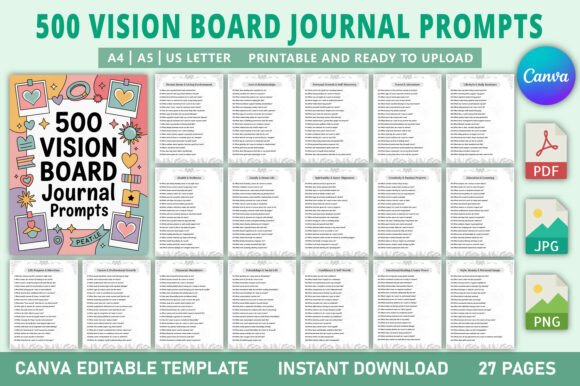
In an era defined by rapid notifications, fragmented attention, and ever-shifting priorities, many adults aged 20–50 are quietly redefining what “progress” means—not as external validation, but as internal alignment. That shift has fueled renewed interest in tools that bridge reflection and action—and 500 Vision Board Journal Prompts meets that need with quiet precision. It’s not another generic affirmation list or static printable. It’s a deeply structured, thematically rich workbook designed to support sustained self-inquiry across 23 life domains—from Emotional Healing and Time, Energy & Productivity to Community Belonging and Digital Life. What makes it especially relevant today is how it responds to real behavioral shifts: people aren’t just journaling less—they’re seeking journaling that *works with* their workflows, not against them.
Why Editable Prompts Matter More Than Ever
Static journal templates often fail because they assume a one-size-fits-all rhythm—yet professionals juggle deadlines, creators revise concepts weekly, educators adapt to student needs, and freelancers pivot between clients. The 500 Vision Board Journal Prompts Fully Editable in Canva version acknowledges this reality. Unlike locked PDFs or rigid printables, it lets users adjust fonts for readability during late-night reflection, swap color palettes to match seasonal energy (e.g., calming blues for rest cycles, warm terracottas for creative sprints), or rearrange layouts to prioritize sections most urgent *right now*. A coach might highlight Confidence & Self-Worth prompts before client sessions; a small business owner may emphasize Career Professional Growth and Financial Abundance while planning Q3 goals. That flexibility isn’t convenience—it’s respect for how people actually think, plan, and evolve.
From Vision Boards to Vision Practices—How the Format Evolved
Vision boards were once synonymous with collaged magazine cutouts and aspirational images pinned to corkboards. While still valuable, their limitations became apparent: they’re static, rarely revisited, and often disconnected from daily habits. Today’s users expect integration—not decoration. The 500 Vision Board Journal Prompts workbook reflects that evolution by anchoring each prompt in actionable reflection. For example, instead of “What does your dream home look like?”, it asks: “Which three sensory details (light, sound, texture) would make your living environment feel like sanctuary—and what’s one small change you can make this month to invite more of that?” That subtle shift—from passive imagining to embodied, incremental design—mirrors broader trends in behavioral psychology and habit science. People don’t need more motivation; they need better scaffolding for translating desire into behavior.
Real-World Use Across Roles and Routines
The strength of this resource lies in its adaptability across contexts:
- For KDP publishers and content creators: The fully editable Canva format allows quick localization—changing examples for regional audiences, adjusting tone for niche markets (e.g., minimalist professionals vs. holistic wellness practitioners), or adding brand-aligned cover designs without design overhead.
- For coaches and educators: Prompts like “When did you last feel deeply aligned with your values during a work decision? What made it possible?” spark nuanced conversations far beyond surface-level goal-setting. They serve as discussion anchors—not fill-in-the-blank exercises.
- For busy professionals: The multiple print sizes (A4, A5, US Letter) mean the same content fits a desk-bound planner, a pocket-sized notebook for commute reflections, or a tablet-friendly layout—supporting consistency across environments.
- For freelancers and solopreneurs: Sections like Technology Digital Life and Lifestyle Daily Routines help audit digital clutter or energy drains—practical when autonomy brings both freedom and boundary challenges.
Crucially, none of these applications require adopting a new system. The prompts integrate seamlessly into existing habits—whether used with bullet journals, Notion dashboards, or printed weekly spreads.
Design That Serves Substance, Not Just Aesthetics
Many journal resources over-prioritize visual appeal at the expense of cognitive ease. The 500 Vision Board Journal Prompts avoids that trap. Its clean typography, intentional white space, and consistent section headers reduce cognitive load—so users focus on meaning, not deciphering layout. The inclusion of diverse themes—from Spirituality & Inner Alignment to Giving, Service & Contribution—reflects growing recognition that well-being isn’t siloed. Research increasingly shows that purpose-driven action (e.g., mentoring, volunteering, community-building) correlates strongly with long-term resilience and life satisfaction. These prompts don’t prescribe answers; they invite exploration within frameworks that honor complexity.
Not Just for “Dream Chasing”—But for Grounded Decision-Making
There’s a misconception that vision work is only for big life transitions—career changes, relocations, major milestones. In practice, the most powerful use of 500 Vision Board Journal Prompts happens in quieter moments: a midweek pause to reassess whether current projects align with Personal Growth & Self-Discovery; a monthly review asking, “Where did I compromise my boundaries—and what would honoring them look like next time?” These aren’t fluffy questions. They’re diagnostic tools—helping users detect misalignment before burnout sets in, spot emerging interests before they become distractions, and recognize patterns in relationships, routines, or finances that might otherwise go unexamined.
Meeting Modern Expectations Without Overpromising
Today’s audience is skeptical of “unlock your dream life” language—unless it’s paired with tangible structure. This workbook delivers that balance: the phrase “Unlock your dream life” isn’t marketing fluff here—it refers to removing friction between intention and implementation. When a user edits a prompt in Canva to reflect their specific definition of Success & Achievements, or adjusts spacing to accommodate longer handwritten reflections, they’re not just customizing a document. They’re practicing agency—the very skill vision work aims to strengthen. That’s why educators use it in goal-setting units, therapists recommend it for values clarification, and product teams apply its framework to user empathy mapping: because clarity begins with precise, personal questioning.
A Resource That Grows With You
Unlike consumable planners that expire after 12 months, the 500 Vision Board Journal Prompts is built for longevity. Its thematic breadth ensures relevance across life stages—someone exploring Family Home Life at 30 may return to Adventure & Courage or Future Vision at 45 with fresh perspective. The editable format also supports iterative growth: a user might start with basic font swaps, then later add icons, embed QR codes linking to audio reflections, or layer in habit trackers beside prompts about Health & Wellness. That capacity for evolution mirrors how human development actually works—not in linear leaps, but in layered, responsive cycles.
Ultimately, 500 Vision Board Journal Prompts succeeds because it treats intentionality as a practice—not a product. It doesn’t promise transformation on command. Instead, it offers 500 thoughtful invitations—to pause, clarify, choose, and gently recalibrate. In a world pulling relentlessly forward, that kind of grounded, customizable support isn’t just useful. It’s necessary.