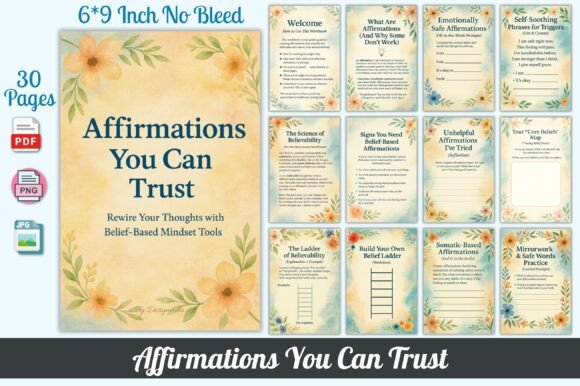
Affirmations You Can Trust
Most affirmation practices fail—not because they’re inherently flawed, but because they ask your nervous system to believe something it hasn’t yet experienced. When you say “I am wildly successful” while sitting in a cluttered inbox with three overdue client calls, your brain registers dissonance, not direction. That’s where Affirmations You Can Trust differs: it’s built on neurobiological realism, not aspirational fantasy. It doesn’t demand leaps; it supports grounded steps. This isn’t about bypassing difficulty—it’s about building cognitive scaffolding that holds up under real-world pressure.
Why Believability Is Your Strategic Advantage
In high-stakes environments—whether launching a product, managing a team, or navigating career transitions—your inner dialogue directly influences decision speed, risk calibration, and emotional stamina. A statement like “I handle uncertainty with clarity” lands differently than “I’m always confident.” The former acknowledges reality (uncertainty exists) while reinforcing agency (you *handle* it). That subtle distinction reduces internal friction, freeing mental bandwidth for analysis, communication, and execution.
Affirmations You Can Trust uses the ladder method precisely because it mirrors how neural pathways actually strengthen: through repetition of *plausible*, context-anchored statements. For example, moving from “I’m not sure I can lead this project” → “I’m learning how to lead this project well” → “I make thoughtful decisions as this project unfolds” creates measurable shifts in self-perception over time—not overnight, but in alignment with actual experience. That progression builds credibility with yourself, which compounds into stronger positioning, clearer boundaries, and more resilient communication.
Strategic Use Cases Across Roles
You don’t need to be “into affirmations” to benefit from Affirmations You Can Trust. Its utility emerges most clearly when tied to specific operational or developmental goals:
- For creators and marketers: Before drafting messaging or pitching ideas, use the “Self-Belief Journaling Prompts” to surface assumptions blocking authentic voice—e.g., “I worry my perspective isn’t valuable enough.” Reframing that into “My perspective matters because it reflects real experience” sharpens positioning and reduces over-editing.
- For educators and team leads: The “Bedtime Mindset Reset Pages” help decompress after emotionally demanding interactions. Consistent use lowers baseline reactivity, improving response quality during high-stakes conversations—like feedback sessions or parent-teacher conferences.
- For freelancers and small business owners: When pricing services or negotiating scope, limiting beliefs often surface as physical tension (“My rates aren’t competitive”) or hesitation (“I should just do it for exposure”). The ladder method helps identify the belief beneath the behavior—and replace it with a statement rooted in evidence: “I set rates that reflect my expertise and sustain my capacity.”
- For decision-makers evaluating tools or workflows: Affirmations You Can Trust functions as a low-friction habit anchor. Pairing it with existing routines—like reviewing your calendar each morning or reflecting post-meeting—builds consistency without adding overhead. That consistency is what transforms mindset work from occasional inspiration into durable infrastructure.
When and How to Apply It Intentionally
Random use dilutes impact. To integrate Affirmations You Can Trust strategically:
- Start with one recurring friction point. Not “I want to feel better,” but “I pause before responding to critical emails.” Identify the thought pattern underneath (“I’ll get it wrong,” “They’ll think I’m defensive”). Then select the corresponding ladder-step affirmation—not the final rung, but the one that feels *just barely stretchable*.
- Anchor it to an existing habit. Print the 6 x 9 inch PDF and place it next to your journal, beside your laptop, or inside your planner. Or load the PNG into GoodNotes and tag it to your daily review template. The goal is environmental cueing—not willpower.
- Pair it with micro-reflection. After using an affirmation, spend 60 seconds noticing: What shifted? Did your shoulders relax? Did your breath deepen? Did a different option occur to you? These are data points—not proof of transformation, but evidence of neural engagement.
- Review monthly—not for perfection, but for calibration. Flip back through your journal entries. Where did the ladder method accelerate progress? Where did you skip rungs or rush? Adjust based on what your actual experience shows—not what productivity culture says “should” happen.
Risks of Using Affirmations Without Context
Without intention, even gentle affirmations can reinforce avoidance. Saying “I am at peace with my workload” while ignoring unsustainable deadlines doesn’t build resilience—it masks burnout. Similarly, repeating “I trust my intuition” without developing discernment between anxiety and insight can erode judgment.
The risk isn’t in the words—it’s in divorcing them from action, observation, and accountability. Affirmations You Can Trust includes “Daily Reflection Spaces” for this reason: to create space between statement and outcome. If “I communicate my needs clearly” appears in your journal but your calendar remains overbooked and your messages vague, the affirmation isn’t failing—you’re missing the feedback loop. That’s useful intelligence, not failure.
Long-Term Value: Building Cognitive Infrastructure
Mindset work isn’t about feeling good. It’s about increasing your capacity to act with integrity, adapt to complexity, and maintain clarity amid ambiguity. Over six months of consistent, ladder-based practice, users report measurable shifts—not in mood alone, but in outcomes: fewer misaligned client engagements, faster recovery from setbacks, clearer prioritization during resource constraints.
This happens because Affirmations You Can Trust trains two interdependent skills: self-observation (noticing what you believe before you speak or decide) and cognitive flexibility (holding multiple perspectives without collapsing into self-criticism or denial). Those are the same skills that enable strong branding (staying aligned with core values while adapting tone), effective operations (adjusting systems without losing purpose), and sustainable customer experience (responding to feedback without losing confidence in your offering).
Practical Planning Tip: Start Small, Track Honestly
Don’t commit to 30 days. Commit to three uses—spaced across one week—with honest reflection afterward. Ask: Did this shift my attention? Did it change how I approached a specific task? Did it reveal a hidden assumption? If yes, continue. If not, revisit your starting point: Was the affirmation too distant? Was the timing disconnected from real pressure? Was there no follow-up action?
The printable format of Affirmations You Can Trust supports this kind of iterative refinement. You can highlight, annotate, tear out pages, or digitize only what serves your current phase. There’s no “correct” way—only what aligns with your goals, capacity, and current reality.
Final Strategic Observation
Tools don’t transform outcomes—consistent, context-aware application does. Affirmations You Can Trust succeeds where others stall because it treats mindset not as decoration, but as operational architecture. It assumes you’re already competent, already trying, already navigating complexity—and offers precise, believable language to reinforce what’s already working, while gently expanding what’s possible. That’s not motivation. It’s leverage.