CBT for Addiction Recovery Workbook: A Practical Path to Lasting Change
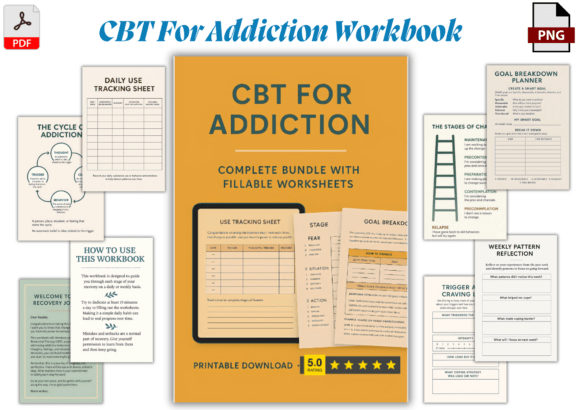
Recovery from addiction isn’t about sudden transformation—it’s about consistent, compassionate action. When cravings surge, negative thoughts spiral, or daily stressors threaten progress, what’s needed isn’t just motivation, but a reliable, evidence-informed system. That’s where the CBT for Addiction Recovery Workbook steps in: a 26-page, printable PDF and PNG resource grounded in cognitive behavioral therapy (CBT), designed not as theory—but as daily practice.
For many adults navigating recovery—whether after detox, during outpatient care, or in self-guided healing—the biggest challenges aren’t always the absence of willpower. They’re the unexamined thought patterns (“I’ve already messed up—I might as well keep going”), the lack of real-time coping strategies when triggers arise, and the quiet erosion of confidence that comes from feeling stuck in cycles of relapse and regret. These aren’t personal failures—they’re signals that the brain needs structured support to rewire old habits and build new neural pathways. CBT offers exactly that—and the CBT for Addiction Recovery Workbook makes it accessible, actionable, and deeply personal.
This workbook meets people where they are. Its calming sage green and beige design reduces visual overwhelm—a small but meaningful detail for those managing anxiety or emotional exhaustion. Measuring 6x9 inches, it’s sized for portability and clarity: large enough to write freely, compact enough to carry in a bag or keep on a nightstand. And because it’s delivered as both a printable PDF and individual PNG files, users can choose how they engage—printing physical copies for tactile reflection, importing pages into note-taking apps, or projecting exercises during therapy sessions.
Let’s look at how the CBT for Addiction Recovery Workbook translates clinical principles into lived experience:
- Daily Use Tracking Sheets help users notice patterns—not just *what* happened, but *when*, *how*, and *what preceded it*. Did a craving peak mid-afternoon after a difficult conversation? Did mood dip before checking social media? Over time, these observations become data—not judgment—and reveal personalized leverage points for change.
- The Thought Awareness & Reframing Practice guides users through identifying automatic negative thoughts (“I’ll never stay sober”) and gently testing their accuracy against evidence (“I’ve gone 17 days without using—and I used tools each time I felt shaky”). This isn’t positive thinking; it’s cognitive flexibility—building mental resilience one honest, grounded reframe at a time.
- The Coping Skills Toolbox moves beyond generic advice like “call a friend” or “take deep breaths.” Instead, it invites users to inventory *their own* effective strategies—what truly works *for them*, in *their* environment—and then build a personalized plan with layered options (e.g., “If distraction fails, I’ll use grounding + reach out to my sponsor within 5 minutes”).
- The Fear Ladder supports gradual, self-paced exposure—especially helpful for those avoiding situations tied to past substance use (e.g., parties, certain neighborhoods, or even idle time). By breaking avoidance into small, manageable steps, users reclaim agency instead of waiting for fear to disappear.
- The Relapse Prevention Blueprint doesn’t assume relapse is inevitable—but it does treat it as *informative*. It walks users through reflecting on warning signs, reviewing what helped in past recoveries, and updating their plan *before* crisis hits. This proactive stance builds confidence, not dread.
Outcomes emerge not from completion, but from repetition. One person may use the CBT for Addiction Recovery Workbook alongside weekly therapy—bringing completed thought records to session for collaborative review. Another may work through it independently over six weeks, pairing daily tracking with morning journaling. A third might use the SMART Goal Breakdown Planner to prepare for a major life transition—like returning to work or repairing a relationship—while keeping cravings and self-talk in check.
Therapists and coaches find the workbook especially valuable because it extends the therapeutic hour. Rather than relying solely on memory or vague intentions between sessions, clients arrive with concrete insights, completed reflections, and questions rooted in real experience. That shifts conversations from “What should I do?” to “What did I learn—and what’s next?” Meanwhile, individuals using it solo benefit from its scaffolding: no prior CBT knowledge is required, yet the structure honors their intelligence and autonomy.
Importantly, the CBT for Addiction Recovery Workbook normalizes imperfection. The Weekly and Monthly Reflection Pages don’t ask, “Did you succeed?” They ask, “What did you notice? What surprised you? Where did you show up—even briefly—with kindness toward yourself?” That subtle shift—from performance to presence—is where sustainable healing begins. And the printable Certificate of Completion isn’t about finishing perfectly—it’s a tangible acknowledgment of effort, growth, and the quiet courage it takes to keep choosing recovery, day after day.
Practical considerations matter too. Because it’s digital-first, users avoid shipping delays or subscription fees. They print only what they need—reusing pages, adjusting font size for accessibility, or highlighting sections that resonate most. There’s no login, no algorithm, no ads—just focused, human-centered support. For mental health advocates distributing resources to underserved communities, the PNG format allows easy adaptation for low-bandwidth settings or printed handouts in group workshops.
If you’ve tried recovery tools that felt too rigid, too vague, or too clinical—the CBT for Addiction Recovery Workbook offers a different rhythm: gentle but intentional, structured but flexible, science-backed but soul-aware. It doesn’t promise overnight freedom from struggle. Instead, it equips you with tools to meet struggle with clarity, respond—not react—to urges, and recognize progress in ways that feel true: a full night’s sleep, a repaired boundary, a moment of curiosity instead of shame.
Change isn’t about perfection. It’s about showing up—with honesty, patience, and the right support. The CBT for Addiction Recovery Workbook is more than paper and ink. It’s a companion for the work that matters most: rebuilding trust—in yourself, your capacity, and your future.