Cut and Paste Activity Book for Kids
Imagine a quiet morning where your child sits at the kitchen table, scissors in one hand, glue stick in the other, carefully matching bright red, blue, and yellow shapes to balloon outlines on the page. There’s focus, laughter, and a little bit of sticky fingers—just the kind of joyful learning that sticks with kids long after the glue dries. That’s the heart of the Cut and Paste Activity Book for Kids: a simple, printable resource designed not just to keep little hands busy, but to build real developmental skills through play.
What This Activity Book Really Does (Beyond the Fun)
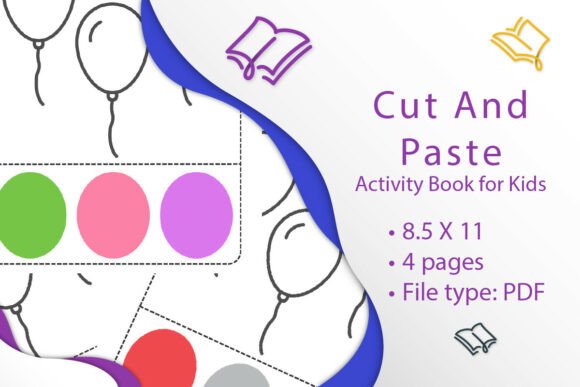
At its core, this Cut and Paste Activity Book for Kids is a targeted tool for early childhood development. Each of the four activity sheets features large, friendly balloon outlines and corresponding color-coded cut-out shapes—no tiny details or confusing directions. Children choose a shape, cut it out along clear dotted lines, and paste it inside the matching balloon. It’s deceptively simple, yet quietly powerful.
The repetition builds fine motor control—the small muscles in the hands and fingers needed for writing, buttoning clothes, and using utensils. The color-matching strengthens visual discrimination and vocabulary (“Which one is *purple*? Where does the green balloon go?”). And because cutting requires guiding the scissors while watching the line, and pasting means lining up the shape just right, hand-eye coordination gets consistent, low-pressure practice.
Why Parents, Teachers, and Caregivers Reach for This Book
You don’t need a teaching degree to see why this resource fits so naturally into daily life. For homeschooling families, it’s a ready-to-go 15-minute activity that supports curriculum goals without screen time. In kindergarten classrooms, teachers use it as a center rotation—quiet, independent, and easily differentiated (some kids match by color name; others by visual cue alone). On rainy afternoons or during travel, it’s a portable, mess-manageable way to shift energy from restlessness to calm engagement.
It also meets practical needs adults care about: no prep beyond printing and gathering basic supplies (child-safe scissors, glue stick or glue dots), no login or device required, and zero ads or distractions. Unlike many digital alternatives, it encourages tactile exploration—a sensory experience screens simply can’t replicate.
Real-Life Ways It Fits Into Different Settings
- At home: Use it as part of a “learning station” alongside playdough or counting bears. Pair it with a short color-themed storybook for a mini literacy + motor combo.
- In preschool or kindergarten: Print multiple copies and laminate the balloon outlines for reuse with stickers—or let kids paste directly for a one-time creative keepsake.
- For therapists or special educators: Adapt easily—offer verbal prompts, use thicker paper for easier cutting, or introduce color words gradually based on individual readiness.
- For small business owners or creators: Bundle it with other early-learning printables in a themed shop (e.g., “Back-to-School Starter Pack”) or offer it as a free lead magnet to grow an email list focused on parenting or early education.
What’s Inside—and Why the Details Matter
This isn’t a generic collection of clipart and lines. Every element serves a purpose:
- PDF format: Ensures crisp, consistent printing on standard home or school printers—no formatting surprises.
- 8.5 x 11 inch pages: Fits most printers and binders, and gives kids enough space to cut comfortably without frustration.
- Four unique sheets: Enough variety to hold interest across multiple sessions—not so many that it feels overwhelming, not so few that it loses value quickly.
- Instructions on each page: Clear icons and minimal text mean even pre-readers understand what to do. Adults can step back and observe, rather than constantly direct.
- Instant download: No waiting, no shipping fees—ideal when you need an activity *now*, whether it’s 7 a.m. before school or 4 p.m. during an unexpected meltdown.
Things to Keep in Mind Before You Start
While the Cut and Paste Activity Book for Kids is thoughtfully designed, a few practical notes help set everyone up for success:
First, consider your child’s current skill level. If they’re just beginning to use scissors, start with one sheet at a time—and model how to hold the scissors and follow the line slowly. Thick paper (like 24 lb. copy paper) holds up better than flimsy printer paper when cutting and gluing.
Second, think about materials. A glue stick works well for quick drying and less mess, but glue dots give stronger hold if you plan to display finished pages. Child-safe, blunt-tip scissors are non-negotiable—never substitute with adult tools, even “just for a second.”
Third, remember that the goal isn’t perfection. Crooked cuts or slightly off-center pasting are part of the learning process. Praise effort (“I love how carefully you held those scissors!”) more than outcome. That kind of encouragement builds confidence far more than any perfectly aligned balloon ever could.
A Thoughtful Tool, Not Just Another Printable
There are thousands of free coloring pages online—but few support the same blend of cognitive, physical, and emotional growth in such a focused, accessible way. The Cut and Paste Activity Book for Kids doesn’t try to be everything. It does one thing well: invites children to learn through doing, choosing, and creating—with color, motion, and intention.
That makes it useful for more than just “keeping kids busy.” It’s a bridge between play and preparation—helping them get ready for handwriting, following multi-step directions, and even early problem-solving (“This shape doesn’t fit—what’s another one I can try?”). And for the adults guiding them, it’s a rare moment where educational value and genuine enjoyment align—no negotiation, no resistance, just curiosity and glue.
If you’ve ever watched a child light up while completing a task all on their own—even something as simple as filling a balloon with the right color—you already know the quiet power of this kind of hands-on learning. That spark? It starts here.