Habit Building Discipline Workbook
Have you ever watched someone rise steadily toward their goals—calm, consistent, and seemingly unshaken by setbacks—while you wrestle with starting, restarting, or abandoning your own plans? The difference isn’t talent, luck, or even time. It’s habit building discipline: the quiet, daily architecture of behavior that compounds into lasting change. The Habit Building Discipline Workbook was created for those who are done waiting for motivation to strike—and ready to build momentum instead.
More Than a Planner—A Behavioral Compass
This isn’t another generic habit tracker. The Habit Building Discipline Workbook is a thoughtfully structured, experience-informed guide grounded in behavioral psychology, neuroscience, and real-world practice. It meets you where you are—not as a blank slate, but as a person with existing routines, emotional triggers, energy patterns, and self-talk habits. Its power lies in its progression: from awareness to intention, from experiment to integration, from slip-ups to resilience.
How It Works—Chapter by Chapter
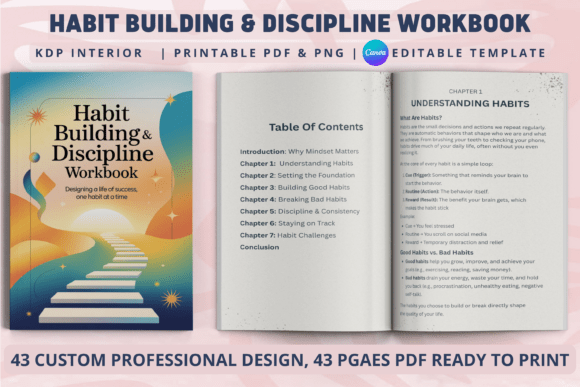
The workbook unfolds across seven focused chapters, each designed to deepen understanding *and* prompt action:
- Introduction: Sets the tone by reframing success—not as a destination, but as the cumulative effect of aligned daily choices. It invites reflection on how mindset shapes perception of effort, progress, and “failure.”
- Chapter 1: Explains the habit loop (cue → craving → response → reward) in plain language—no jargon, just clarity. You’ll map one current habit to see how it operates automatically—and why willpower alone rarely overrides it.
- Chapter 2: Guides you through auditing your environment, energy rhythms, and identity narratives. Why? Because sustainable habit change begins with honest self-context—not idealized versions of yourself.
- Chapter 3: Offers practical, low-barrier strategies—like habit stacking, 2-minute starts, and environment design—to make new behaviors easy, obvious, and satisfying.
- Chapter 4: Moves beyond “just stop” advice. You’ll identify the function a “bad” habit serves (e.g., stress relief, boredom avoidance), then co-create healthier alternatives that fulfill the same need.
- Chapter 5: Focuses on discipline as a skill—not an innate trait. Exercises include designing friction for distractions, using commitment devices, and tracking consistency (not just outcomes).
- Chapter 6 & 7: Address the human reality: motivation fades, life interrupts, and old patterns resurface. These chapters equip you with recovery rituals, progress-reframing tools, and boundary-setting scripts for common derailers like overwhelm, comparison, or all-or-nothing thinking.
The Canva Editable Template: Flexibility Meets Function
Alongside the core workbook comes the Habit Building Discipline Workbook – Canva Editable Template. This isn’t just a digital version—it’s a customizable system. Whether you’re a visual thinker who thrives on color-coded timelines, a minimalist who prefers clean whitespace, or a team leader adapting exercises for coaching clients, Canva lets you tailor layouts, fonts, icons, and sections without design expertise.
You can:
- Swap out journal prompts to match your industry (e.g., “What’s one client interaction I can improve this week?” for service professionals)
- Add your brand colors and logo for internal team use or client-facing resources
- Resize worksheets for print or screen—ideal for hybrid workspaces or remote coaching sessions
- Translate key pages for bilingual audiences or global teams
Real People, Real Shifts
Consider Maya, a freelance graphic designer who struggled with inconsistent workflow and frequent burnout. Using the Habit Building Discipline Workbook, she identified her “procrastination loop”: email notifications (cue) → anxiety about scope (craving) → scrolling social media (response) → temporary relief (reward). With Chapter 4’s framework, she replaced scrolling with a 90-second breathing exercise *before* opening email—and used Chapter 2’s environment audit to mute non-urgent notifications entirely. Within three weeks, her deep-work blocks increased by 40%.
Or James, a small-business owner overwhelmed by reactive tasks. He used the Canva template to build a weekly “Focus Ritual” page—embedding his top 3 priority habits (reviewing cash flow every Monday, blocking 2 hours for strategy every Thursday, and sending one appreciation note to a team member each Friday). The visual layout made consistency feel tangible—not abstract.
Who Benefits Most—and When It Fits Best
The Habit Building Discipline Workbook shines for people who value structure *with space for humanity*. It’s especially helpful for:
- Professionals navigating transitions: Onboarding into leadership, shifting to remote work, launching a side project—or recovering from burnout.
- Creators and solopreneurs: Who manage multiple roles without built-in accountability and need systems that scale with changing priorities.
- Coaches, HR managers, and educators: Who use the Canva template to adapt exercises for group workshops, onboarding kits, or wellness initiatives.
- Students and lifelong learners: Building study routines, reducing digital distraction, or cultivating curiosity-driven habits—not just productivity hacks.
It’s less suited for those seeking quick fixes or rigid, one-size-fits-all schedules. This workbook assumes growth is iterative—and honors that progress includes pauses, pivots, and recalibrations.
Strengths That Stand Out
What makes this resource distinct isn’t novelty—it’s integration:
- Science-backed, not trend-driven: Concepts align with research from James Clear, BJ Fogg, and Angela Duckworth—but translated into accessible, actionable steps.
- No “guilt-by-default” framing: Instead of shaming missed days, it teaches how to read slips as data—not failure.
- Emphasis on identity shift: Exercises ask, “Who becomes the person who does this consistently?”—making habits feel self-reinforcing, not imposed.
- Designed for reuse: Unlike dated planners, the content stays relevant across years, goals, and life stages.
Practical Considerations
While powerful, the Habit Building Discipline Workbook works best when paired with realistic expectations:
- Time investment: Plan for 15–30 minutes per chapter initially. Later reflections may take less than 5 minutes—especially once habits settle.
- Not a substitute for clinical support: If habits are tied to anxiety, depression, trauma, or addiction, this workbook complements—but doesn’t replace—therapy or medical care.
- Requires active engagement: Reading alone won’t shift behavior. The value lives in completing the written exercises, not skimming them.
Your Next Step Isn’t “Perfect”—It’s Intentional
Building discipline isn’t about becoming inflexible or joyless. It’s about choosing what matters—and designing your days so those choices become automatic. The Habit Building Discipline Workbook doesn’t promise overnight transformation. It offers something more reliable: a repeatable process for turning intention into instinct.
Whether you’re aiming to write daily, eat more mindfully, lead with calm, launch a business idea, or simply show up for yourself with greater consistency—the first page isn’t about fixing everything. It’s about asking one clear question: What’s one small, sustainable action I can honor tomorrow?
That question—and the thoughtful, compassionate structure of the Habit Building Discipline Workbook—is where real, resilient change begins.