Kids Animal Movement Somatic Cards
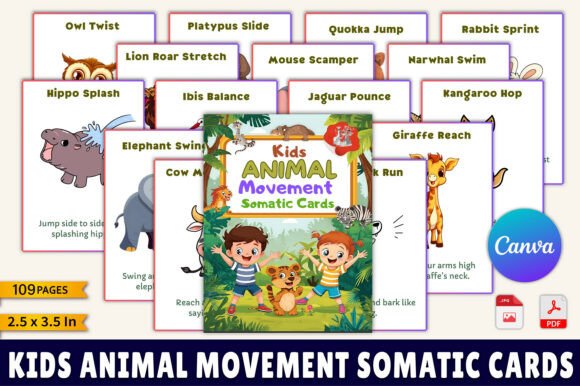
Children don’t learn best when sitting still. They learn through movement, rhythm, sensory input, and embodied play—especially when regulation, attention, or motor development is emerging. Kids Animal Movement Somatic Cards respond directly to that reality: a practical, well-designed set of 109 animal-themed movement prompts grounded in somatic principles, not just novelty. Unlike generic “brain break” cards, these integrate body awareness, intentional action, and developmental intention—making them useful across multiple professional contexts without requiring specialized training.
A Thoughtful Bridge Between Play and Regulation
Somatic practices for children emphasize internal sensing—how the body feels during motion, stillness, resistance, or balance—not just external performance. The Kids Animal Movement Somatic Cards reflect this understanding. Each prompt (e.g., “Unicorn Prance,” “Bear Stomp,” “Dolphin Jump”) pairs a familiar animal archetype with a specific gross motor pattern: weight shifting, contralateral coordination, vestibular stimulation, or proprioceptive input. These aren’t arbitrary; they map to evidence-informed strategies used in occupational therapy, trauma-informed education, and early childhood motor development frameworks.
In practice, this means a “Penguin Waddle” isn’t just fun—it engages core stability, bilateral coordination, and slow-motion control. A “Frog Leap” supports landing mechanics, knee alignment, and breath coordination. That consistency across prompts matters: it allows educators and therapists to select cards intentionally, not randomly, based on observed needs—whether calming an overstimulated student before writing time or waking up sluggish attention before circle time.
Design That Supports Real-World Use
The physical and digital execution reinforces usability. At 2.5×3.5 inches, the cards fit comfortably in small hands and standard card holders—no awkward trimming or laminating required. Illustrations are clean, high-contrast, and expressive without visual clutter, supporting children with diverse processing styles, including those with ADHD or autism. Text is minimal and action-oriented (“Stomp like a bear—feet wide, knees bent, arms heavy”), avoiding abstract language or multi-step directions that can derail engagement.
The inclusion of editable Canva templates is a notable strength for professionals who adapt resources regularly. Teachers can add classroom-specific cues, therapists can embed sensory diet notes, and curriculum designers can align cards with learning objectives—all without design expertise. The 109 unique templates avoid redundancy while maintaining thematic cohesion; there’s no filler. Each card stands on its own functionally, yet the full set builds cumulative familiarity—children begin recognizing patterns (e.g., “grounding animals” vs. “lifting animals”), deepening their somatic literacy over time.
Where These Cards Deliver Consistent Value
Kids Animal Movement Somatic Cards perform especially well in three overlapping scenarios:
- Classroom transitions: Used as 60–90 second “reset rituals,” they reduce verbal redirection and support collective regulation. One kindergarten teacher reported a 40% reduction in transition-related friction after introducing two consistent cards per day—“Octopus Float” for quieting and “Bunny Hop” for re-engagement.
- Therapeutic co-regulation: Occupational and speech therapists use them as low-pressure entry points into body-based work—particularly with children who resist traditional “exercises.” The animal framing lowers demand sensitivity while preserving therapeutic intent.
- Home-based support: Parents appreciate the clarity and brevity. No setup, no equipment, no screen time—just immediate, scaffolded movement. A pediatric OT noted families were more likely to follow through with home programs when prompts felt playful rather than clinical.
This versatility isn’t accidental. The cards avoid age-specific scripting (e.g., no “for ages 4–7” labels), allowing natural differentiation: a preschooler might sway gently as a “Tree Frog,” while a third grader adds rhythmic clapping or breath counting. That scalability extends longevity—educators report reusing the same set across grade levels with minor adaptation.
Practical Considerations and Limitations
No resource replaces skilled observation or individualized planning—and Kids Animal Movement Somatic Cards don’t claim to. They’re a tool, not a curriculum. Their effectiveness depends on how adults introduce, model, and reflect on the movements. For example, saying “Let’s try the Owl Turn—notice how your neck feels as you look behind you” invites interoception; rushing through the motion without naming sensation misses the somatic layer entirely.
There are also contextual limits. In large-group settings where space is constrained (e.g., crowded urban classrooms), some prompts—like “Gazelle Gallop” or “Whale Dive”—require minor modification. Similarly, children with significant mobility differences may need paired adaptations (e.g., seated “Elephant Trunk Swings” instead of standing). The current set doesn’t include explicit modification guidance, though the Canva files make adding those notes straightforward.
Print quality is consistently strong in the PDFs—crisp lines, accurate colors, no pixelation—even at small scale. However, users printing at home should verify ink saturation and paper weight; thinner stock may curl or wear quickly with frequent handling. Laminating remains advisable for high-use environments like therapy clinics or shared classroom bins.
Who Benefits Most—and How to Integrate Them Effectively
Educators new to movement-based regulation will find Kids Animal Movement Somatic Cards accessible without oversimplifying. The animal lens provides immediate entry points for lesson integration—linking “Butterfly Stretch” to a science unit on metamorphosis, or “Wolf Howl Breath” to social-emotional vocabulary around big feelings. For experienced practitioners, the set offers reliable scaffolding: a consistent visual language that reduces cognitive load during fast-paced instructional moments.
Therapists using sensory integration or polyvagal-informed approaches will recognize familiar foundations in the movement architecture—just repackaged for broader accessibility. Freelance curriculum developers and content creators can leverage the Canva files to build companion resources: printable journals, progress trackers, or bilingual versions—without recreating illustrations from scratch.
For maximum impact, start small. Choose three cards aligned with recurring classroom or therapeutic needs (e.g., one for calming, one for focus, one for energy release) and use them consistently for two weeks. Observe shifts in group regulation, participation rates, or verbal self-reporting. Then expand—not by adding more cards, but by deepening reflection: “What did your feet feel like during the Bear Stomp?” “When did your breath change during the Dolphin Jump?” That emphasis on internal noticing is where somatic learning takes root.
Ultimately, Kids Animal Movement Somatic Cards succeed because they honor children’s need for joyful, intelligent movement—and respect adults’ need for tools that are both grounded and flexible. They don’t promise transformation, but they do offer a reliable, repeatable way to bring attention back into the body, one thoughtful, animal-inspired action at a time.