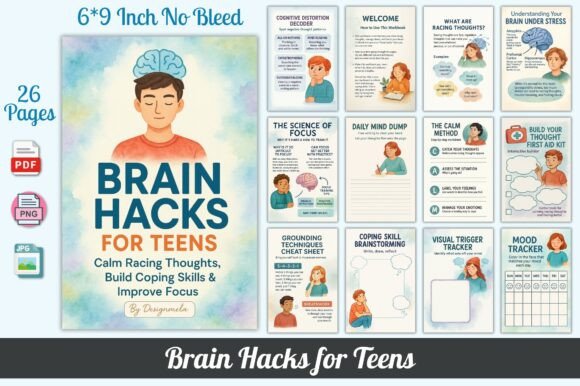
📘 Brain Hacks for Teens
Teens today aren’t just juggling school, friendships, and identity—they’re navigating a world of constant notifications, social comparison, and high-stakes expectations, all while their prefrontal cortex is still wiring itself. That’s why 📘 Brain Hacks for Teens – A Printable Workbook for Calming Racing Thoughts, Building Coping Skills, and Boosting Focus isn’t just another journal or worksheet pack. It’s a developmentally grounded, research-informed toolkit designed *with* teen neurobiology in mind—not against it.
But here’s what many adults miss: buying or printing this workbook isn’t the finish line. It’s the first step—and how you introduce, adapt, and support its use makes all the difference in whether it lands as a lifeline or gathers dust in a drawer.
Common Missteps—and Why They Undermine Real Results
Mistake #1: Assuming “printable” means “plug-and-play.” Some educators download 📘 Brain Hacks for Teens, hand it to a student during homeroom, and expect immediate calm. But racing thoughts don’t pause for photocopies. The workbook’s power lies in *intentional scaffolding*: introducing one tool at a time (like the CALM Method Worksheet), modeling how to use it aloud (“I notice my shoulders tightening—I’m catching that thought”), and allowing space for messy, imperfect practice. Without that context, even the clearest grounding exercise can feel like homework—not relief.
Mistake #2: Overlooking the “why” behind each section. The Thought First Aid Kit isn’t just colorful cards—it’s built on cognitive behavioral principles and polyvagal theory. When teens label an emotion (“This is anxiety, not danger”), their amygdala gets a signal that the threat has passed. Skipping the brief explanation before the doodling mind dump pages means missing the neuroscience anchor that helps teens trust the process. Without that foundation, creative expression stays surface-level instead of becoming regulation.
Mistake #3: Treating mood tracking like data entry. The mood tracker in 📘 Brain Hacks for Teens includes subtle prompts—“What happened right before this feeling peaked?” or “Where did I feel it in my body?”—not just smiley-face ratings. When parents or counselors ask only, “How was your day?” without linking emotions to physical cues or triggers, they miss patterns that could reveal sleep debt, screen fatigue, or unmet needs. That turns a powerful self-awareness tool into a vague diary.
What to Check Before You Print, Share, or Assign
Before using 📘 Brain Hacks for Teens, ask yourself three practical questions:
- Is the teen invited—not instructed—to engage? Autonomy builds buy-in. Try: “Would you like to try the grounding page before your next test? No pressure—we can do two minutes or skip it.”
- Are you modeling the tools yourself? Teens notice when adults use breathwork before a meeting, jot down worries before bed, or name their own frustration aloud. That quiet consistency speaks louder than any worksheet.
- Is there room for adaptation? The focus routines are customizable—but only if you co-create them. A student overwhelmed by deadlines might need a “5-Minute Reset” version of the study plan; another may thrive with visual timers and color-coded sections. The printable format invites that flexibility—if you use it.
Better Approaches—Backed by Real Use
In a high school counseling office in Portland, a counselor stopped assigning full workbook pages and started with *one card* per week from the Thought First Aid Kit. Students kept it taped inside lockers or saved it as a phone wallpaper. One sophomore began using the “Catch-Label-Manage” prompt before checking Instagram—and reported fewer post-scroll crashes. That wasn’t magic. It was consistency, relevance, and low barrier to entry.
Another parent didn’t print the entire workbook upfront. She printed only the Grounding Exercises and the Certificate of Completion—then framed the certificate *before* her daughter finished anything. “We celebrated the intention first,” she shared. “She ended up doing three doodle pages that week—just because she felt seen, not fixed.”
And educators using the CALM Method Worksheet in advisory periods found better results when they paired it with a 60-second audio guide (recorded on their phone) walking students through noticing breath and naming sensations—no tech required, no extra prep.
Why This Isn’t Just Another Resource
Unlike generic mindfulness apps or dense psychology PDFs, 📘 Brain Hacks for Teens bridges science and simplicity. The calming visuals aren’t decorative—they’re designed to reduce cognitive load. The brain-based strategies reflect real developmental windows: labeling emotions strengthens neural pathways between the limbic system and prefrontal cortex. Even the paper size (8.5" x 11") is intentional—large enough for expressive drawing, small enough to tuck into a backpack.
It also avoids common pitfalls of teen mental health materials: no toxic positivity, no oversimplified “just breathe” messaging, and no assumption that every teen has quiet space or privacy at home. The mind dump pages work with scribbles, symbols, or single words. The grounding exercises include seated, standing, and movement-based options. That flexibility isn’t an afterthought—it’s baked into the design.
A Final Note for Adults Supporting Teens
You don’t need to be a therapist, educator, or expert to use 📘 Brain Hacks for Teens well. You do need curiosity, patience, and willingness to learn alongside the teen. Start small. Notice what resonates—not what looks impressive on paper. Celebrate the attempt, not just the outcome. And remember: the goal isn’t to eliminate racing thoughts or big feelings. It’s to help teens build a relationship with their inner world—one where they feel capable, connected, and quietly confident in their own capacity to respond—not react.
That shift doesn’t happen from a single worksheet. It happens across dozens of tiny, repeated moments—when a teen chooses the CALM Method over scrolling, draws chaos onto a mind dump page instead of holding it in, or pauses long enough to feel their feet on the floor. 📘 Brain Hacks for Teens gives structure to those moments. Your presence, openness, and steady support gives them meaning.