The Social Survival Workbook for Teens
Today’s teens—especially those on the autism spectrum—navigate a social landscape unlike any previous generation. Communication happens across screens and in person, often simultaneously. Expectations shift rapidly: one moment, a teen is expected to self-advocate in a classroom; the next, they’re asked to decode unspoken group dynamics in a Discord server or manage sensory overload during a school assembly. Traditional social skills curricula often miss the nuance—overlooking how neurodivergent thinking shapes perception, energy, and connection. That’s where The Social Survival Workbook for Teens stands apart: not as a prescriptive “fix,” but as a responsive, affirming companion designed with—and for—neurodivergent minds.
Why This Resource Fits Where Modern Support Falls Short
Many well-intentioned tools assume a linear path to social competence: learn the rule, practice the script, repeat. But real-world social navigation isn’t scripted—it’s contextual, iterative, and deeply tied to emotional regulation, energy management, and self-trust. Recent shifts in education, mental health care, and parent advocacy reflect this understanding. Schools increasingly adopt Universal Design for Learning (UDL), recognizing that flexibility in engagement benefits *all* learners—not just those with formal accommodations. Meanwhile, therapists and educators report rising demand for resources that avoid masking pressures and instead honor autistic communication styles: visual processing strengths, need for predictability, preference for concrete language, and value placed on authenticity over performance.
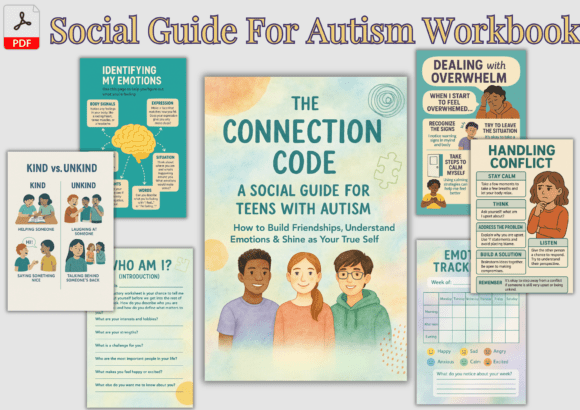
The Social Survival Workbook for Teens meets this moment precisely. Its 39-page structure doesn’t try to cover every possible scenario. Instead, it offers grounded entry points—emotion logs with color-coded intensity scales, illustrated “overwhelm maps” showing physical cues before verbal ones, and friendship reflection prompts that ask, “What made this interaction feel safe?” rather than “Did you make eye contact?” That subtle pivot—from compliance to coherence—aligns with evidence-informed practices like the Double Empathy Problem framework, which acknowledges that social challenges arise from mutual misunderstanding, not deficit.
Designed for Real-Life Use—Not Just Theory
Practicality is built into every detail. The 6x9 inch size fits seamlessly into bullet journals, therapy notebooks, or compact desk planners—no awkward cropping or scaling needed. The dual PDF + PNG format means educators can drop individual pages into digital learning platforms (like Google Classroom or Canvas) without losing interactivity, while parents or therapists can print single worksheets for targeted sessions. One teacher recently shared how she uses the “Brave Steps” tracker alongside her student’s IEP goals—breaking down “initiate conversation with peer” into micro-actions like “pass a note with a sticker” or “stand near group during lunch.” Progress isn’t measured in frequency alone, but in felt safety and agency.
The watercolor illustrations aren’t decorative—they serve cognitive function. Soft gradients reduce visual stress; consistent iconography (e.g., a recurring “calm anchor” symbol across emotion regulation and conflict resolution pages) builds recognition and recall. Even the typography prioritizes readability: open letterforms, generous line spacing, and intentional white space prevent cognitive crowding—critical for teens whose executive function may be taxed by dense text or competing visual stimuli.
How Professionals Are Integrating It Into Evolving Workflows
For therapists, the workbook functions as both assessment tool and intervention scaffold. Rather than starting with abstract questions about “how do you feel?”, clinicians use the emotion log to co-identify patterns: “I notice your ‘frustration’ spikes after transitions—what’s happening in your body right before class changes?” That data informs session planning and helps teens connect internal experience to external context.
In classrooms, special educators use the “Support Network Pages” to collaboratively map trusted adults and peers—not as a static list, but as a living document updated weekly. A high school counselor described how her students began adding notes like “Sam lets me sit quietly at lunch” or “Ms. Lee gives me 10 seconds to process before answering”—transforming vague concepts of “support” into tangible, observable behaviors.
For parents, the resource reduces the pressure to be expert instructors. The clear, non-judgmental language (“Your brain might need more time to decide what to say—that’s okay”) models respectful dialogue. And because it’s printable and modular, families can start small: one page per week, revisited when energy allows—not another item on an already overwhelming to-do list.
More Than a Workbook—A Shift in How We Define Social Success
This isn’t about preparing teens to blend in. It’s about equipping them to belong—on their own terms. That distinction matters deeply in a cultural moment where neurodiversity is moving beyond awareness into actionable inclusion. Companies now seek autistic talent for pattern recognition and systems thinking; universities offer neurodivergent support programs rooted in strength-based mentoring; even social media platforms are introducing features like customizable notification filters and reduced-motion settings—acknowledging that accessibility isn’t optional, it’s foundational.
The Social Survival Workbook for Teens reflects that evolution. Its goal-setting tracker doesn’t measure conformity—it invites reflection on values: “What kind of connection feels meaningful to *you*?” The friendship activities don’t teach “how to get invited to parties”; they explore boundaries, reciprocity, and how to recognize when a relationship drains or sustains energy. One teen used the “Goal Ladder” to outline steps toward asking a classmate to study together—not because it was socially expected, but because she wanted help understanding chemistry concepts *and* valued collaborative learning.
Realistic Expectations, Sustainable Practice
No resource replaces human connection, skilled support, or systemic change. But what makes The Social Survival Workbook for Teens effective is its humility: it assumes teens are already doing their best with the tools they have. It meets them where they are—whether that’s needing quiet strategies before entering a crowded hallway, wanting to understand why sarcasm feels confusing, or simply seeking permission to rest after social effort.
That realism extends to creators and professionals too. You don’t need to overhaul your entire curriculum or clinical approach to begin. Start with one section—perhaps the calming strategies worksheet during a transition period, or the weekly reflection page as a low-stakes check-in. Observe what resonates. Adapt the language. Leave space for “not today.” Because sustainable social growth isn’t about speed or volume—it’s about consistency, compassion, and honoring neurodivergent ways of being in the world.
Who Benefits—and How
- Educators gain ready-to-use, inclusive materials that align with SEL standards while respecting diverse learning profiles.
- Therapists and counselors receive a flexible framework for building self-awareness without pathologizing natural variation.
- Parents and caregivers access gentle, non-shaming language that supports daily conversations—not just crisis moments.
- Teens themselves encounter a resource that treats them as experts of their own experience, not problems to be solved.
- Content creators and curriculum designers find a model for neuroinclusive design—prioritizing clarity, choice, and sensory awareness without sacrificing depth.
In a world that often demands adaptation without offering scaffolding, The Social Survival Workbook for Teens provides something rare: structure that empowers, visuals that soothe, and questions that invite—not interrogate. It doesn’t promise effortless social success. It offers something more valuable: the quiet confidence that comes from knowing your needs matter, your pace is valid, and your way of connecting is worthy of support.