Money Saving Tips for Kids
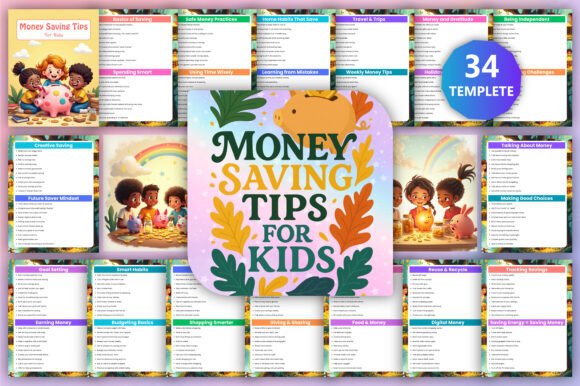
📝 Money Saving Tips for Kids is a printable and editable planner designed to introduce children—typically ages 6 to 12—to foundational financial concepts through age-appropriate structure and engagement. It is not a standalone curriculum or digital app, but a hands-on, activity-based tool that supports learning through doing: tracking allowances, setting small goals, practicing price comparisons, and reflecting on spending choices. The planner uses visual cues, simple language, and recurring prompts to reinforce habits without relying on abstract theory.
Families often seek resources like 📝 Money Saving Tips for Kids when they notice their child struggles with delayed gratification, spends allowance quickly, or lacks awareness of how money works in everyday life. Others turn to it during transitions—starting school, receiving first allowances, or preparing for bigger purchases like toys or event tickets. It also appeals to educators and caregivers looking for low-prep, screen-free tools aligned with elementary financial literacy standards.
The planner’s value lies in its consistency and scaffolding. Rather than presenting isolated facts, it integrates concepts across contexts: budgeting appears alongside shopping lists; coin-value practice ties into goal-tracking; eco-conscious habits (like reusing containers or choosing secondhand items) connect to both saving money and reducing waste. This cross-linking helps children see money management as part of broader decision-making—not just math or rules.
One key benefit is its emphasis on agency. Children record their own goals, choose challenges, and reflect on outcomes—building confidence through ownership. The inclusion of family engagement prompts encourages shared conversations about values, trade-offs, and priorities, which research shows strengthens long-term financial behavior more than instruction alone.
However, effectiveness depends on consistent use and adult support. Without regular check-ins or modeling from caregivers, the planner may become another unused workbook. It assumes a baseline level of literacy and fine motor skills, making it less suitable for early readers or children with significant learning differences unless adapted. Also, while the editable Canva link allows customization, users need basic familiarity with Canva to modify layouts or add personal examples—some may prefer pre-formatted PDFs instead.
Another consideration is scope. 📝 Money Saving Tips for Kids focuses on saving, mindful spending, and basic budgeting—not investing, banking systems, or income generation. It does not replace conversations about earning money (e.g., chores vs. allowances), nor does it cover digital payments or online safety in depth. Families seeking those topics will need supplemental materials.
The planner is strongest when used as part of a broader approach—not as a one-time activity, but as a weekly ritual. For example, families who sit together each Sunday to review progress, adjust goals, and plan upcoming purchases tend to report higher engagement and retention. Its visual layout and challenge-based format also suit children who respond well to gamified learning, especially those motivated by tangible milestones (e.g., “Save $10 for a book” or “Go one week without asking for candy”).
It may be less ideal in situations where structure feels restrictive rather than supportive. Children who resist written tasks, have high anxiety around performance, or thrive with open-ended exploration may find the planner’s format overwhelming. In such cases, alternatives like storytelling-based money books, physical piggy banks with clear compartments, or simple apps with audio guidance could offer gentler entry points.
Similarly, households with limited access to printing or devices may find the Canva-based format less practical than fully offline, no-print options—such as reusable dry-erase boards or laminated charts. And for older children (ages 11–13), the tone and visuals may feel too young; they might benefit more from teen-focused budgeting templates or real-world simulations like managing a mock checking account.
When evaluating whether 📝 Money Saving Tips for Kids fits your needs, consider three questions:
- What is your primary goal? If you want to build routine, encourage reflection, and support early habit formation with minimal prep, this planner aligns well. If you’re aiming for rapid skill acquisition or addressing specific behavioral concerns (e.g., frequent impulse buys), pairing it with direct coaching or behavioral strategies may yield better results.
- How much time and involvement can you commit? The planner works best with 10–15 minutes per week of guided interaction. If consistency is difficult due to scheduling or competing priorities, a simpler, lower-friction tool may be more sustainable.
- Does your child respond to visual, tactile, or game-like learning? Those who enjoy coloring, checking off boxes, or collecting stickers often engage deeply with the planner’s format. Children who prefer movement-based or auditory learning may need adaptations—or different resources entirely.
Finally, remember that financial literacy develops gradually. No single tool guarantees mastery. What matters most is repetition, relevance, and responsiveness: connecting money lessons to real choices (“Should we buy snacks today or save for the park?”), adjusting expectations as skills grow, and affirming effort over perfection. 📝 Money Saving Tips for Kids provides one thoughtful, accessible pathway—but it’s one piece of a larger ecosystem of learning, modeling, and conversation.
If you’re comparing options, look beyond features and ask: Which resource invites ongoing use? Which reflects your family’s values around money, sustainability, and responsibility? And which meets your child where they are—not where you hope they’ll be? Answering those questions thoughtfully often matters more than selecting any single product.