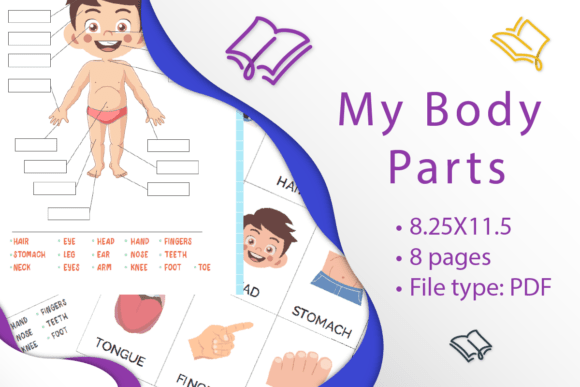
My Body Parts: A Thoughtful Guide for Educators and Caregivers
If you’re supporting young children’s early learning—whether in a preschool classroom, homeschool setting, or during quiet moments at home—you’ve likely searched for resources that teach anatomy without overwhelming little learners. My Body Parts Busy Book is one such resource: an 8-page printable PDF designed to help toddlers, preschoolers, and kindergarteners explore the human body through play-based, screen-free interaction. It’s not flashcards alone or passive coloring—it’s matching, cutting, pasting, labeling, and naming, all grounded in real-world visuals and inclusive illustrations.
Why This Resource Stands Out (and Why That Matters)
Many anatomy-themed printables lean heavily on cartoonish silhouettes or gender-neutral stick figures—well-intentioned, but limited in helping kids connect vocabulary to actual, observable features. My Body Parts avoids that pitfall by using clear, realistic body part images alongside both male and female representations. Children see eyes, ears, noses, and mouths as they appear—not stylized abstractions—and pair them with simple, consistent word labels like “knee,” “elbow,” and “ankle.” That realism supports accurate vocabulary development and builds foundational science awareness long before formal biology begins.
A Common Misstep: Assuming All “Body Parts” Printables Are Equal
Not every busy book delivers what it promises—and some fall short in ways that affect usability, not just aesthetics. For example, some downloads include low-resolution images that pixelate when printed, making fine motor tasks like cutting along outlines frustrating rather than supportive. Others use overly complex fonts or tiny label boxes, which undermine the very skills they aim to build: visual discrimination, hand-eye coordination, and early reading readiness.
With My Body Parts, the 8.25×11.5 inch page size gives ample space for little hands to cut and manipulate. The word tiles are sized for small fingers—not too large to misalign, not so small they vanish under a toddler’s grip. And because it’s delivered as a high-quality PDF (not a JPEG or web screenshot), printing remains crisp across home inkjets and school laser printers alike.
Another Overlooked Detail: Gender Inclusion Done Right
Some anatomy resources default to one gender illustration—or worse, alternate between “boy” and “girl” pages without explaining that most body parts function the same way across sexes. That can unintentionally reinforce stereotypes or leave gaps in understanding. My Body Parts includes side-by-side male and female figures on key labeling pages, paired with neutral, functional language (“We use our eyes to see”). This subtle but important framing helps children notice similarities first—supporting empathy, accuracy, and inclusivity from the start.
What to Check Before You Download
Before purchasing any digital educational resource—including My Body Parts—take two minutes to verify these practical details:
- File format and compatibility: Ensure it’s a true PDF (not a ZIP of unformatted images) and opens cleanly in Adobe Reader or Preview. Test one page before printing a full set.
- Page layout and margins: Look for previews showing full bleed or safe margins—especially if your printer trims edges. Cropped labels or clipped illustrations make activities unusable.
- Vocabulary alignment: Scan the word list. Does it match your curriculum goals or developmental stage? “Wrist” and “ankle” are appropriate for age 4+, while “ulna” or “patella” belong elsewhere.
- Accessibility considerations: Are colors high-contrast? Is font weight sufficient for emerging readers? My Body Parts uses bold, sans-serif type and distinct color coding—no light grays or thin strokes that fade when photocopied.
Avoiding the “More Is Better” Trap
It’s tempting to assume that a 30-page mega-pack must be more valuable than an 8-page focused set. But research in early childhood education consistently shows that quality trumps quantity—especially for attention spans under five minutes. Too many pages can dilute focus, increase prep time for adults, and lead to incomplete activities. My Body Parts intentionally limits scope: eight intentional, sequenced pages that move from identification (matching pictures to words) to application (labeling blank outlines). Each step builds on the last—no redundancy, no filler.
Realistic Use Cases—Not Just “Ideal” Ones
You don’t need laminators, storage bins, or lesson plans to get value from this resource. One educator uses the cut-and-paste pages during morning choice time—children work independently while she rotates small groups. A parent keeps the flashcards in a zip-top bag for car rides, turning red-light stops into quick naming games. A speech-language pathologist integrates the labeling worksheets into articulation practice, pairing “tongue” with /t/ sound drills and “nose” with nasal resonance awareness.
That flexibility comes from thoughtful design—not marketing buzzwords. There’s no “teacher prep required!” claim hiding hours of cutting. Everything is ready to print, cut once, and use. No external materials needed beyond scissors, glue, and paper.
Final Practical Note: Digital ≠ Automatic
Because My Body Parts is a digital download—not a shipped kit—it’s easy to overlook the final step: saving the file properly. Some users open the PDF in a browser, click “print,” and assume that’s enough. But browsers sometimes compress images or ignore embedded fonts. Instead, download the file directly, open it in a dedicated PDF reader, and select “Actual Size” under page scaling before printing. That one adjustment ensures labels align precisely with cut lines and images retain clarity.
What This Means for Your Teaching—and Their Learning
When children name their own body parts with confidence, they’re not just memorizing words—they’re building self-awareness, communication skills, and the foundation for health literacy. My Body Parts supports that quietly, consistently, and respectfully. It doesn’t shout. It doesn’t overpromise. It offers clean design, inclusive representation, and developmentally grounded tasks—all in eight pages you can print today and use tomorrow.
If your goal is meaningful engagement—not just busy work—this is a resource worth choosing with intention. And if you’ve already downloaded it? Try starting with just one page: the matching activity. Watch how your child pauses to compare ear shape, point to their own chin, or say “I have two eyes—just like the picture!” That moment—simple, unhurried, grounded in their own experience—is where real learning lives.