Beginner’s Guide to Smart Investing
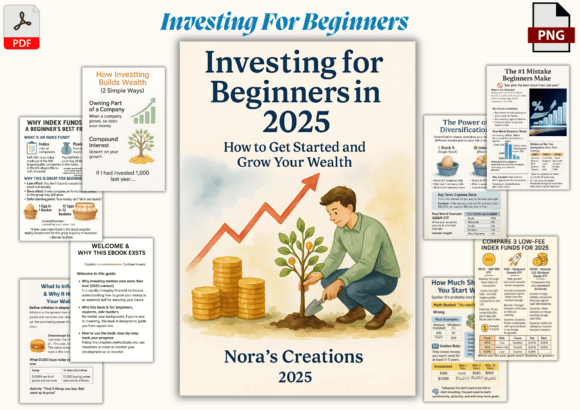
Starting to invest can feel overwhelming—especially when faced with unfamiliar terms, conflicting advice, and a flood of financial products. The Beginner’s Guide to Smart Investing is a 25-page illustrated resource designed to simplify core concepts for people with little or no prior experience. It’s not a brokerage platform, investment recommendation tool, or certified financial advice. Instead, it functions as a structured learning companion: a printable and digital educational planner that introduces foundational ideas through visual explanations, comparisons, and actionable checklists.
This guide targets readers who are in the early stages of financial literacy—students building long-term habits, part-time workers beginning to save beyond a checking account, or anyone seeking clarity before opening their first brokerage account. Its format—a set of high-resolution PNG pages plus a ready-to-print PDF—makes it adaptable for both digital note-taking and physical journaling. The watercolor-style, vertical 6x9-inch layout prioritizes readability and engagement over dense text, using illustrations to clarify topics like compound growth, inflation’s impact on purchasing power, and how index funds differ from individual stocks.
Why Consider This Resource?
Many new investors struggle not with access to information, but with filtering what’s essential. Traditional investing books often assume baseline knowledge or dive into technical detail too quickly. In contrast, the Beginner’s Guide to Smart Investing focuses on conceptual scaffolding: explaining *why* diversification matters before detailing specific ETF tickers, or illustrating *how* small, consistent contributions grow over time—not just stating the math. Its inclusion of tools like a 30-day habit tracker and monthly auto-invest sheet supports behavior change, recognizing that investing success depends as much on consistency as on strategy.
The guide also addresses common psychological barriers. Illustrated myth-busting sections—such as “You need thousands to start” or “Timing the market beats holding long term”—help correct misconceptions without judgment. A built-in glossary and capital gains reference sheet serve as quick-reference anchors, reducing the need to search elsewhere for definitions or tax basics.
What to Expect—and What It Doesn’t Replace
Readers should expect clarity, structure, and visual reinforcement—not personalized portfolio construction or real-time market analysis. Because it’s static (not interactive or updated), it won’t reflect changes in tax law, fee structures of specific funds, or shifts in regulatory guidance after publication. It also doesn’t include live links, calculators, or integration with financial apps. Its value lies in distillation, not depth: a starting point, not a destination.
That said, its practical orientation helps bridge the gap between theory and action. The step-by-step walkthrough for opening a brokerage account walks through document requirements, identity verification steps, and transfer methods—common friction points for first-time users. Comparison charts of low-fee index funds provide illustrative examples (e.g., VTI vs. FXAIX) with clear criteria like expense ratio, minimum investment, and asset class—but do not endorse specific providers or substitute for due diligence on current fund offerings.
When This Guide Fits Well
The Beginner’s Guide to Smart Investing is especially useful for learners who benefit from visual organization and prefer self-paced study. It suits those who:
- Want a tangible, offline-friendly way to absorb fundamentals—without relying solely on videos or articles;
- Are building a personal finance journal or habit-tracking system and need compatible, print-ready content;
- Prefer concise, modular lessons over lengthy textbooks or fragmented blog posts;
- Need gentle reinforcement of core principles before committing time or money to courses or advisors.
Its emphasis on behavioral tools—like the habit tracker—also makes it relevant for readers who recognize that knowledge alone rarely leads to action. If your goal is to internalize concepts *and* begin practicing them consistently, this format supports both.
When to Explore Alternatives
This guide may be less suitable if you’re looking for:
- Real-time or personalized guidance: It does not adapt to income level, debt obligations, risk tolerance, or geographic tax rules. Someone with student loans, variable income, or dependents may need more tailored analysis than a general primer provides.
- Interactive learning: Readers who learn best through quizzes, simulations, or algorithm-driven portfolio suggestions may find static pages limiting compared to platforms offering guided onboarding or robo-advisor tools.
- Regulatory or legal nuance: While it introduces capital gains basics, it doesn’t cover state-specific filing requirements, retirement account contribution limits for 2025, or implications of international investing—topics better addressed by official IRS resources or licensed professionals.
- Advanced strategy development: Once past the fundamentals—understanding asset allocation, rebalancing, or tax-loss harvesting—investors will need deeper, more specialized materials.
Making a Practical Decision
Before choosing this guide—or any beginner resource—consider two questions: What do I want to understand first? and How do I learn best? If your priority is grasping the relationship between time, contribution size, and compound growth—and you retain information more easily through diagrams than paragraphs—this guide offers focused support. If, however, you’re unsure whether to prioritize paying down high-interest debt before investing, or whether a Roth IRA fits your situation, a broader introductory course or one-on-one consultation may better address your immediate context.
Also consider accessibility: since it’s delivered as downloadable files, it requires basic tech literacy to open, annotate, or print. Those without reliable internet access or device compatibility may prefer library-based books or community workshops. And while the guide avoids complex jargon, readers with limited English proficiency or learning differences may benefit from supplemental audio or multilingual resources.
Ultimately, the Beginner’s Guide to Smart Investing serves as one credible entry point—not the only one. Its strength is in lowering the activation energy to begin: transforming abstract goals like “build wealth” into concrete actions like “set up $50/month auto-transfer” and “review fund expense ratios.” For readers ready to move from curiosity to consistent practice, it offers a grounded, visually supported foundation—provided expectations align with its scope as an introductory educational tool.