Why the 200 Mental Self-Care Prompts Journal Is Reshaping How Creators Support Emotional Wellness
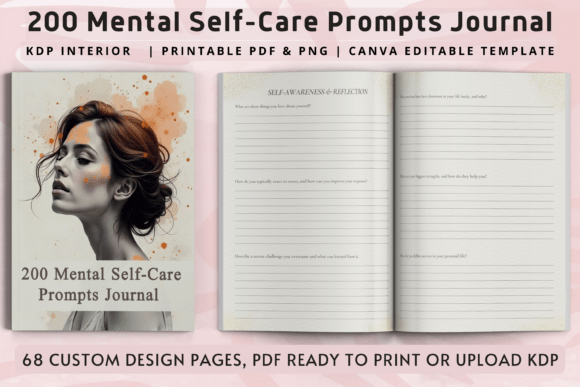
Self-care isn’t just about bubble baths and quiet mornings—it’s about consistent, intentional mental maintenance. In a world where burnout is normalized and emotional fatigue goes unaddressed, tools that invite reflection—not distraction—are rare. That’s where the 200 Mental Self-Care Prompts Journal stands out: not as another generic planner, but as a purpose-built scaffold for inner clarity.
A Journal Designed for Real Life—Not Just Aesthetic Appeal
Many journals promise transformation but deliver only blank pages and vague encouragement. The 200 Mental Self-Care Prompts Journal flips that script. Every prompt is grounded in evidence-informed practices—mindfulness, cognitive reframing, gratitude anchoring, boundary exploration, and values clarification. You won’t find filler questions like “What’s your favorite color?” Instead, you’ll encounter prompts such as:
- “When did I last say ‘no’ without guilt—and what made it possible?”
- “What emotion have I been avoiding this week? Where do I feel it in my body?”
- “What small act of kindness toward myself would feel like a relief right now?”
These aren’t theoretical exercises. They’re entry points—gentle, nonjudgmental invitations to reconnect with yourself amid daily noise. And because they’re embedded in a Canva editable template, creators can adapt tone, language, and framing to match their audience’s needs—whether that’s teens navigating social pressure, remote workers managing isolation, or caregivers rebuilding emotional reserves.
More Than a Journal—A Scalable Asset for Content Creators
For self-publishers and digital entrepreneurs, the 200 Mental Self-Care Prompts Journal isn’t just a product—it’s infrastructure. Its Canva-editable source file removes technical barriers. No design software licenses. No font licensing headaches. No layout rework from scratch. Just open, customize, export, and publish.
Think about how this fits into real-world workflows:
- A wellness coach adds her signature affirmations to the “This Book Belongs To” page and swaps out prompts to align with her signature 30-day resilience framework.
- An indie author bundles the journal with her debut memoir on anxiety—offering readers not just insight, but immediate, actionable reflection space.
- A mental health nonprofit adapts the template for teens, replacing abstract language with relatable phrasing (“What made you pause today?” instead of “Describe your somatic response to stress”) and exports a low-cost printable version for school workshops.
The minimalist, elegant design does heavy lifting here too. Clean lines, ample white space, and balanced typography reduce visual overwhelm—critical when supporting people who may already feel emotionally taxed. It signals calm before a single word is read.
Why Editability Matters—Especially on Amazon KDP
Low-content publishing on Amazon KDP thrives on speed, consistency, and compliance. But many templates stumble on one or more of those fronts: fonts that don’t embed properly, bleed settings that trigger rejection, or layouts that break across devices. The 200 Mental Self-Care Prompts Journal was built with KDP’s requirements baked in—from the precise 8.5×11-inch PDF with bleed to the 68-page count optimized for interior formatting rules.
And because it includes both a ready-to-upload PDF and the Canva source file, creators avoid the common trap of choosing between convenience and control. You can launch fast—or iterate deeply. Launch one version for Instagram followers, tweak colors and headers for a LinkedIn audience, and test a bilingual edition—all without redesigning from zero.
Practical Benefits You Can’t Get From Generic Templates
Let’s name what makes this more than “just another journal”:
- Prompt diversity with intention: The 200 prompts span categories—self-compassion, energy awareness, relationship patterns, future visioning, grief acknowledgment, joy tracking—not as isolated themes, but as interwoven threads. This mirrors how mental wellness actually unfolds: nonlinear, contextual, layered.
- No fluff, no filler: Each prompt serves a function. Some invite grounding (“Name three things you can hear right now”). Others challenge limiting beliefs (“What would I tell my best friend if they said this about themselves?”). None exist solely for visual rhythm.
- Bonus book cover included: Not a placeholder graphic—but a professionally designed, fully customizable cover. Match fonts, adjust color overlays, insert your logo, and maintain brand cohesion across your entire catalog—without hiring a designer for every release.
- Accessibility-aware structure: Ample line spacing, legible sans-serif options, and clear visual hierarchy support users with ADHD, anxiety-related focus shifts, or visual processing preferences.
Who Benefits Most—and Why Timing Matters
This isn’t just for therapists or life coaches. It’s for:
- Content creators launching niche communities: Pair the journal with a private Discord group or email series—prompt participants weekly, then discuss insights live. The journal becomes your engagement engine.
- Small business owners building digital product suites: Bundle it with a guided audio series or printable habit tracker. The 200 Mental Self-Care Prompts Journal serves as the reflective anchor in a broader ecosystem.
- Educators and HR professionals: Adapt prompts for team check-ins, leadership development, or student SEL (social-emotional learning) curricula—no copyright concerns, full editing rights.
Timing matters, too. With rising searches for “mental wellness journal,” “self-reflection prompts,” and “printable therapy tools,” demand is growing—not fading. But volume alone doesn’t guarantee visibility. What moves the needle is specificity. Someone searching for “anxiety journal for adults” won’t click on a generic bullet journal. They’ll choose the 200 Mental Self-Care Prompts Journal because its title, description, and preview images signal relevance—not randomness.
What to Consider Before You Customize
Before diving into Canva, ask yourself:
- Who is my ideal user—and what language resonates with them? A corporate audience may respond to prompts framed around “energy management” and “decision fatigue.” A spiritual audience may prefer “inner wisdom” or “soul alignment” phrasing.
- Do I need supplemental resources? Consider adding a brief “How to Use This Journal” page—not prescriptive, but inviting. Example: “There’s no ‘right’ way to fill this. Try one prompt a day. Skip what doesn’t land. Return to what stirs something.”
- What’s my distribution plan? If offering digitally, ensure your Canva edits export cleanly as PDFs. If printing physical copies, verify CMYK color mode compatibility with your printer—even though the template defaults to print-ready settings.
You don’t need perfection to start. You need clarity of purpose—and the 200 Mental Self-Care Prompts Journal gives you both.
Final Thought: Tools Don’t Heal—But They Can Hold Space
A journal doesn’t fix anxiety. It doesn’t erase grief. It doesn’t replace therapy. What it does—powerfully—is create conditions for healing to begin. The 200 Mental Self-Care Prompts Journal offers structure without rigidity, depth without dogma, and beauty without pretense. For creators, it’s a turnkey way to offer meaningful support. For users, it’s permission—to pause, to question, to soften, to remember themselves.
That’s not just good design. It’s responsible design.