400 Values and Beliefs Journal Prompts
What if you had a tool that didn’t just ask you to reflect—but guided you to uncover what truly matters beneath the surface? The 400 Values and Beliefs Journal Prompts isn’t another generic list of “what are your goals?” questions. It’s a rigorously curated, thoughtfully sequenced collection designed to help adults aged 20–50 clarify their inner compass—especially when life feels misaligned, decisions feel heavy, or purpose seems distant.
Unlike scattered journaling ideas found online, these prompts move beyond surface-level self-talk. They’re grouped into thematic clusters—identity anchors, belief origins, value conflicts, boundary awareness, cultural influences, emotional triggers, and more—so reflection builds momentum rather than stalls in repetition. Each prompt invites specificity: not “What do you value?” but “When did you last act *against* your stated value—and what need were you trying to meet instead?” That kind of precision shifts journaling from habit to insight.
Why structure matters more than volume
Four hundred prompts only help if they’re organized for growth—not overwhelm. This template groups prompts by developmental intent: early sections gently surface assumptions (“What did your family treat as non-negotiable?”), while later ones challenge consistency (“Describe a time your actions contradicted your ethics—and what protected you from noticing it”). That progression mirrors how self-awareness actually deepens: first naming patterns, then tracing roots, then testing resilience.
For coaches and educators, this structure means less prep time and more meaningful client or student engagement. Instead of crafting prompts from scratch—or relying on vague, open-ended questions—you can assign targeted sequences based on observed needs: decision fatigue, career transition, relationship strain, or burnout recovery. One freelance writer used the “Values in Conflict” section to untangle why she kept accepting low-paying projects despite valuing financial autonomy—revealing an unexamined belief that “being helpful” required self-sacrifice.
Designed for real-world use—not just theory
The Canva-editable format is where practicality meets professionalism. You’re not locked into rigid formatting or forced to wrestle with desktop publishing software. Need to adjust font size for older readers? Swap a prompt to match your coaching framework? Add your logo and brand colors before exporting? All possible—without design experience. The clean, minimalist layout avoids visual clutter, keeping attention on the question—not the decoration.
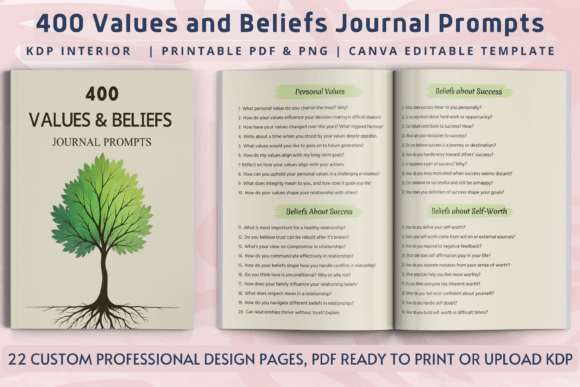
This matters especially for creators preparing KDP low-content books. The template includes bleed-ready PDFs (8.5×11 inches, 21 pages), a customizable cover, a “This Book Belongs To” page, and PNG assets—all tested for Amazon’s upload requirements. No guesswork about margins, resolution, or file types. One small business owner published her branded version in under two hours after purchasing; she now uses it as both a lead magnet and a paid digital download, citing its professional polish as a key reason clients perceive her as credible.
Who benefits most—and how
Personal development coaches find immediate utility: the prompts serve as ready-made session extensions, homework assignments, or self-assessment tools for new clients. Because each prompt is self-contained and context-light, they work across modalities—individual coaching, group workshops, or online courses—without requiring lengthy setup.
Journals and printable creators gain a differentiated product in a crowded market. Rather than competing on aesthetics alone, this template offers depth: 400 Values and Beliefs Journal Prompts stands out because its substance supports measurable outcomes—like identifying recurring conflict patterns or spotting values dissonance before it leads to resentment.
Professionals navigating transitions (career shifts, leadership roles, parenting changes) often report feeling “off-center” without knowing why. These prompts help locate the friction—not just “I’m stressed,” but “I’m compromising my value of intellectual honesty every time I nod along in meetings.” That clarity simplifies decisions: one project manager used the “Boundary Beliefs” cluster to recognize she equated saying “no” with being uncooperative—a belief rooted in early workplace feedback. Once named, she revised her approach—and reduced after-hours email checking by 70%.
A realistic note on fit and intention
This isn’t a quick-fix tool. It won’t replace therapy for deep-seated trauma, nor does it claim to resolve complex systemic barriers like workplace inequity or financial precarity. Its strength lies in supporting intentional awareness—not solving external problems. If your goal is rapid habit change or skill-building (e.g., time management or public speaking), other resources may align more directly.
Also, while the Canva format offers flexibility, users unfamiliar with Canva’s interface may spend 15–20 minutes learning basics like text layering or export settings. That’s minimal compared to designing from scratch—but worth noting if you prefer zero-learning-curve tools. And because the prompts focus on internal exploration, they’re most effective when paired with consistent practice—not occasional use. Think of it like strength training for self-knowledge: results compound over weeks, not days.
How to begin—without pressure
You don’t need to start at prompt #1 or complete all 400. Try this: flip to any page, read three prompts, and choose the one that lands with quiet intensity—not the one that feels “important” or “productive.” Write for five minutes. No editing. No audience. Just presence. Many users discover their most revealing insights come from prompts they initially skipped.
For teams or cohorts, consider using one prompt per week as a shared reflection anchor—then discuss patterns, not answers. A school counselor introduced the “Belief Origins” section to her staff wellness group; within six weeks, teachers began naming how childhood messages about “always being strong” were showing up in their classroom management styles.
The 400 Values and Beliefs Journal Prompts works because it meets people where they are—with respect for complexity, no jargon, and no assumption that clarity comes easily. It doesn’t tell you who to be. It gives you language to notice who you already are—and whether that still fits.