🔥 Learning English AI Prompts: A Practical Framework for Adaptive Language Mastery
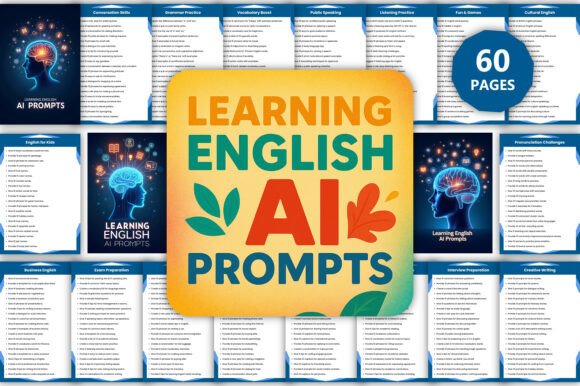
Language learning has long been shaped by repetition, rote memorization, and static textbooks—approaches that often fail to mirror how humans naturally acquire fluency. 🔥 Learning English AI Prompts reimagines this process not as a fixed curriculum, but as a responsive, learner-centered ecosystem powered by artificial intelligence. At its core, it’s a curated architecture of 1000 purpose-built ChatGPT-style prompts—each designed to trigger targeted, contextual, and scaffolded language practice. Unlike generic AI queries (“Explain past perfect tense”), these prompts embed pedagogical intention: they specify audience, output format, difficulty level, real-world framing, and even error-correction parameters. The result is not just interaction with AI—but intelligent co-creation of learning.
How Prompt Design Translates to Cognitive Gains
The effectiveness of 🔥 Learning English AI Prompts lies in its alignment with second-language acquisition research—particularly the principles of comprehensible input (Krashen), output hypothesis (Swain), and task-based language teaching (Ellis). Each prompt functions as a micro-task engineered to activate specific mental processes. For example:
- A beginner-level prompt like “Generate a 6-line dialogue between two neighbors ordering coffee at a café. Use only present simple verbs and food vocabulary. Include one polite request (‘Could you…?’) and one clarification (‘Do you mean…?’)” scaffolds syntax, pragmatics, and high-frequency lexis simultaneously.
- An advanced writing prompt—“Rewrite this business email to improve tone, concision, and cultural appropriateness for a UK-based client. Highlight three changes and justify each using British business communication norms”—integrates genre awareness, sociolinguistic sensitivity, and metacognitive reflection.
This granularity transforms AI from a passive answer engine into an adaptive practice partner. Learners don’t just receive explanations—they negotiate meaning, test hypotheses, revise output, and internalize patterns through iterative, low-stakes engagement.
Real-World Applications Across Diverse User Roles
The utility of 🔥 Learning English AI Prompts extends far beyond self-study. Its modular design supports distinct workflows for educators, professionals, and independent learners—each leveraging the same 1000 prompts in contextually precise ways.
Educators & Language Coaches
Teachers use category-specific prompts to rapidly generate differentiated materials without content creation overhead. A tutor preparing a lesson on phrasal verbs might select five prompts from the “Multi-Word Verbs” section—each yielding unique gap-fill exercises, contextual definitions, or role-play scenarios tailored to student interests (e.g., tech, healthcare, travel). The Bonus Note Pages become collaborative spaces: students annotate AI-generated dialogues with pronunciation notes or flag idioms for deeper discussion. This shifts classroom time from delivery to guided analysis and personalized feedback.
ESL Learners & Self-Directed Students
For autonomous learners, the thematic organization enables intentional practice aligned with immediate goals. Someone prepping for a nursing certification exam might cycle through prompts under “Medical English,” “Exam Speaking Tasks,” and “Academic Vocabulary.” Each prompt yields a custom drill—say, summarizing a patient case study in 90 seconds, then receiving AI feedback on clarity, terminology accuracy, and hedging language (“It appears…”, “This may suggest…”). The absence of rigid progression allows learners to revisit foundational grammar while simultaneously tackling advanced discourse skills—a reflection of real-life language use.
Professionals & Business Users
Non-native English speakers in global roles leverage prompts for authentic workplace simulation. A marketing manager might input: “Draft a 2-minute pitch for a sustainability initiative targeting senior leadership. Use data-driven language, three rhetorical questions, and avoid jargon. Then critique the draft for persuasive structure and cultural assumptions.” The AI generates and analyzes—not as a substitute for judgment, but as a rehearsal tool. Similarly, job seekers practice responses to behavioral interview questions (“Tell me about a time you resolved conflict”) with built-in variation: different industries, seniority levels, and regional English norms (US vs. AU vs. IN).
Structural Intelligence: Why Thematic Categorization Matters
The 50 English learning categories aren’t arbitrary labels—they reflect functional language domains where competence is measured by performance, not knowledge recall. Consider “Public Speaking Practice”: prompts here don’t ask for definitions of rhetorical devices. Instead, they task users with rewriting TED Talk excerpts for clarity, converting technical reports into layperson summaries, or generating impromptu speech stems (“If I had 60 seconds to explain blockchain to my grandmother…”). This mirrors how fluency is assessed: not by identifying subjunctive mood, but by deploying it appropriately in persuasion (“I wish the team were more aligned on timelines”).
Likewise, “Everyday English” focuses on pragmatic competence—the unspoken rules governing interactions. Prompts simulate negotiating rent, interpreting sarcasm in text messages, or navigating ambiguous service encounters (“The waiter said ‘It’ll be right up’—how long should I expect to wait?”). These scenarios train inferencing, cultural calibration, and tolerance for ambiguity—skills rarely addressed in traditional curricula but critical for real-world confidence.
Technical Integration: Beyond ChatGPT
While optimized for ChatGPT, 🔥 Learning English AI Prompts is platform-agnostic. Its prompts follow universal instruction-design principles compatible with Claude, Gemini, Perplexity, and open-source LLMs. Key adaptations include:
- Role specification: Explicitly stating “You are an ESL teacher with 15 years of experience” improves response relevance over generic instructions.
- Output constraints: Limiting responses to bullet points, tables, or 3-sentence summaries prevents verbose, unfocused outputs.
- Feedback loops: Prompts like “Identify three subtle errors in this paragraph and explain why each violates formal academic style” encourage diagnostic thinking—not just correction.
This interoperability future-proofs the resource. As new AI tools emerge with stronger multimodal capabilities, users can adapt existing prompts—for instance, adding “Include phonetic transcriptions using IPA” for pronunciation drills, or “Generate a script suitable for text-to-speech conversion with natural pauses” for listening practice.
Practical Implementation: From Prompt to Proficiency
Effective use hinges on workflow integration—not isolated exercises. A sustainable routine might involve:
- Morning review: Select one “Vocabulary in Context” prompt to generate a short story using 5 target words; highlight how meaning shifts across sentences.
- Afternoon application: Use a “Business Email Rewrite” prompt to refine a real message before sending; compare AI suggestions with your original for tone and concision.
- Evening reflection: On a Bonus Note Page, record one phrase the AI used that felt more natural than your version—and note why (e.g., “‘We’re circling back’ instead of ‘We’ll contact you again’ conveys proactive follow-up”).
This cyclical pattern—generate, apply, analyze—builds what linguists call “noticing ability”: the conscious awareness of linguistic features in authentic use. Over time, learners internalize patterns not as rules, but as reusable resources.
Considerations for Ethical and Effective Use
AI-powered language practice introduces important considerations. First, prompts must guard against over-reliance: 🔥 Learning English AI Prompts explicitly discourages copying AI output verbatim. Instead, it emphasizes transformation—paraphrasing, contrasting versions, or debating AI suggestions. Second, cultural representation matters. The prompts avoid stereotyped scenarios (e.g., “ordering pizza” as the sole American context) and instead draw from global English usage: Indian business negotiations, Nigerian academic conferences, or Singaporean customer service scripts. Third, accessibility is embedded: prompts specifying “Use clear font-friendly formatting” or “Avoid complex metaphors” ensure usability across neurodiverse learners and varying digital literacy levels.
Measuring Progress Beyond Traditional Metrics
Fluency gains from 🔥 Learning English AI Prompts manifest in observable behavioral shifts—not test scores alone. Users report increased willingness to initiate conversations, reduced hesitation during meetings, and greater precision in written communication. Educators track progress through qualitative artifacts: revised drafts showing improved cohesion, recorded speaking attempts demonstrating better intonation contours, or annotated dialogues revealing deeper pragmatic understanding. The PDF’s clean layout and JPG visuals support offline reflection—students sketch concept maps linking idioms to personal experiences, or layer phonetic symbols over printed transcripts.
In essence, 🔥 Learning English AI Prompts doesn’t promise fluency in 30 days. It delivers something more durable: a methodology for making language learning responsive, relevant, and relentlessly human-centered—even when powered by AI.