🏡 2026 Home Schooling Organizer: A Practical Tool for Structured, Sustainable Learning
For families navigating homeschooling in 2026, consistency isn’t just helpful—it’s foundational. The 🏡 2026 Home Schooling Organizer responds directly to that need: a physical, thoughtfully sequenced planner designed not as a rigid script but as a responsive framework. It’s built for adults who manage multiple roles—educator, administrator, scheduler, budgeter, and mentor—all while supporting student growth across academic, behavioral, and emotional domains. Unlike generic planners or digital apps that require setup, customization, or subscription renewals, this organizer arrives pre-structured with integrated systems that align with how homeschooling actually unfolds over time.
What Sets This Planner Apart From Generic Alternatives
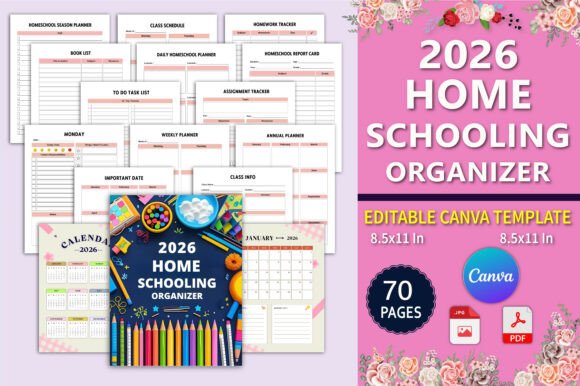
The 🏡 2026 Home Schooling Organizer avoids the trap of overloading pages with decorative elements at the expense of function. Its layout prioritizes usability through intentional spacing, consistent typography, and logical section sequencing—from annual planning (January–December) to seasonal goal buckets (e.g., “Fall Science Exploration” or “Winter Writing Sprint”). Each major component serves a documented pain point: the Lesson Planner includes dedicated lines for objectives, materials, differentiation notes, and follow-up—supporting both curriculum-aligned instruction and spontaneous learning moments. The Progress Trackers go beyond grade logs; they include space for qualitative observations, skill-mastery check-ins, and standardized test prep timelines—valuable for portfolio reviews or state reporting requirements.
One underappreciated strength is its balance between structure and flexibility. Weekly spreads feature time-blocked scheduling but leave room for “floating blocks” labeled “Adapt & Respond”—a subtle but meaningful nod to the reality that homeschool days rarely follow a fixed script. Similarly, the Daily Weekly Planners combine task tracking with reflection prompts (“What helped me focus today?”) and gratitude journaling—not as an afterthought, but as an embedded habit-building layer. This integration reflects an understanding that executive function development is part of the curriculum, not separate from it.
Real-World Use: Where It Delivers—and Where It Requires Input
In practice, the 🏡 2026 Home Schooling Organizer performs best when used as a central coordination hub—not a standalone solution. For example, a parent managing three children across different grade levels might use the Class Subject Organizers to maintain distinct timetables per child, cross-referencing them against the shared Full-Year Calendar to avoid overlapping field trips or assessment windows. The Expense Tracker proves especially useful for families itemizing curriculum purchases, lab supplies, co-op fees, or tutoring costs—each entry supports year-end tax documentation without needing spreadsheet imports.
Quality and presentation are consistently high: thick, lay-flat binding, acid-free paper suitable for pens and light markers, and subtle color-coding (not overwhelming neon accents) that aids visual scanning. Pages are uncluttered but purposeful—no blank filler. That said, it assumes a baseline level of planning literacy. Users new to homeschooling may benefit from pairing it with a short onboarding guide (not included) to fully leverage features like the Goal Setting Pages, which link short-term academic targets to long-term character benchmarks (e.g., “Practice asking clarifying questions during discussions” paired with quarterly self-review prompts).
Audience Fit: Who Benefits Most—and Why
This planner suits educators and parents who value tactile organization and want to reduce cognitive load around logistics. Freelancers or small business owners who homeschool often appreciate its dual-role design: the To-Do Habit Trackers support personal productivity goals alongside student accountability, while the Creative Space sections offer mental reset points amid demanding schedules. Bloggers and curriculum creators also report using it to map content calendars, track resource development milestones, and log reader feedback themes—functions not explicitly marketed but naturally supported by its flexible layouts.
It’s less ideal for families relying exclusively on asynchronous digital platforms (e.g., full-time online schools with automated grading), where manual logging may feel redundant. Likewise, users expecting AI-driven reminders, cloud sync, or auto-generated reports will find it intentionally analog—a choice that supports focus but requires self-directed discipline. Its greatest utility emerges in hybrid or project-based models, where lesson pacing, interdisciplinary connections, and student-led inquiry benefit from visible, editable, paper-based scaffolding.
Practical Recommendations for Effective Use
Start with the Seasonal Planners before the school year begins. These four bucket-list sections encourage backward design: identifying desired outcomes for each season first, then aligning resources, assessments, and enrichment activities. Next, populate the Class Subject Organizers with curriculum scope-and-sequence documents—even if abbreviated—to create anchor points for weekly planning.
Use the Reading Book Logs not just for tracking titles, but for noting discussion questions, vocabulary highlights, and cross-curricular links (e.g., a historical fiction novel paired with timeline work in social studies). And don’t skip the Gratitude Notes section: research shows regular positive reflection improves family engagement in learning, and having it physically adjacent to academic tasks reinforces its relevance—not as an add-on, but as part of the learning ecosystem.
For long-term value, treat the 🏡 2026 Home Schooling Organizer as a living archive. At year’s end, file completed sections—not just grades or test scores, but annotated lesson plans, student reflections, and expense summaries. These become tangible evidence of growth, useful for portfolio reviews, re-enrollment decisions, or even informal mentoring of other homeschooling families.
Final Considerations
The 🏡 2026 Home Schooling Organizer doesn’t promise effortless homeschooling. What it does provide is clarity of intent, reduction of administrative friction, and a consistent rhythm for reviewing what matters—not just what’s assigned. Its effectiveness hinges less on perfection in execution and more on regular, low-stakes engagement: five minutes each morning to review the day’s priorities, ten minutes weekly to update progress trackers, twenty minutes monthly to reflect on seasonal goals. For professionals accustomed to managing complex projects with distributed teams, this planner offers a familiar logic—applied thoughtfully to the unique demands of home-based education. If your workflow thrives on intentionality, tangible feedback loops, and layered yet accessible structure, the 🏡 2026 Home Schooling Organizer is worth integrating—not as a fix, but as a steady companion.